
Ceiling Fan Installation Mistakes You're Making (And How Lawrenceville Electricians Fix Them)
Here are all 15 blog post titles:
- EV Charger Installation Atlanta: 7 Mistakes You're Making (and How to Fix Them)
- Whole House Generator Atlanta: Do You Really Need One? Here's the Truth
- Is Your Electrical Panel Upgrade Atlanta-Ready? 10 Warning Signs You Can't Ignore
- Outdoor Lighting Installation Gwinnett County: 25 Creative Ideas You've Never Thought Of
- Emergency Electrician Atlanta: Why Everyone Is Calling at 2 AM (And You Should Too)
- New 2025 Electrical Codes in Georgia: 7 Things Every Homeowner Must Know Before Their Next Project
- Whole House Generator vs. Backup Battery: Which Is Better for Your Atlanta Home?
- Is Your Marietta Home Ready for an EV? The Complete Guide to Electric Vehicle Charger Installation
- Smart Outdoor Lighting Ideas That Actually Save Money (Plus Installation Tips for Gwinnett County Homes)
- Ceiling Fan Installation Mistakes You're Making (And How Lawrenceville Electricians Fix Them)
- GFCI Outlets in Atlanta Homes: Why They Keep Tripping and What It Really Means
- Electrical Safety During Georgia Storm Season: What Every Homeowner Must Know
- Why Your Electrical Bill Keeps Rising (And 8 Hidden Energy Drains in Your Atlanta Home)
- Smart Home Electrical Upgrades That Actually Add Value to Your Gwinnett County Property
- The Real Cost of Electrical Problems: What Atlanta Homeowners Pay When They Wait Too Long
Now here's the full blog post:
Installing a ceiling fan seems straightforward enough: mount it up, connect some wires, flip the switch. But here's what most homeowners don't realize: even small mistakes during installation can create safety hazards, reduce your fan's lifespan, and leave you with a wobbly, noisy mess that drives you crazy every single day.
This isn't about scaring anyone. It's about understanding that ceiling fans are more complex than they appear, and the installation mistakes people make are surprisingly common: and surprisingly dangerous.
Let's walk through the biggest errors we see in Lawrenceville homes and exactly how professional electricians handle these situations properly.
Mistake #1: Using the Wrong Electrical Box
Most people think any electrical box will do. After all, if it holds a light fixture, it should handle a ceiling fan, right?
Wrong. This is actually one of the most dangerous mistakes you can make.
A standard light fixture electrical box isn't designed to support a ceiling fan's weight and constant vibration. We're talking about a device that weighs 15-50 pounds and creates continuous rotational force. That old plastic box holding your previous light fixture? It's not rated for this kind of stress.
What happens when you use the wrong box: The mounting can fail catastrophically. We've seen fans tear right out of ceilings, damaging drywall and creating serious injury risks. Even if it doesn't fall immediately, the constant vibration weakens the mounting over time, causing the fan to wobble and eventually fail.
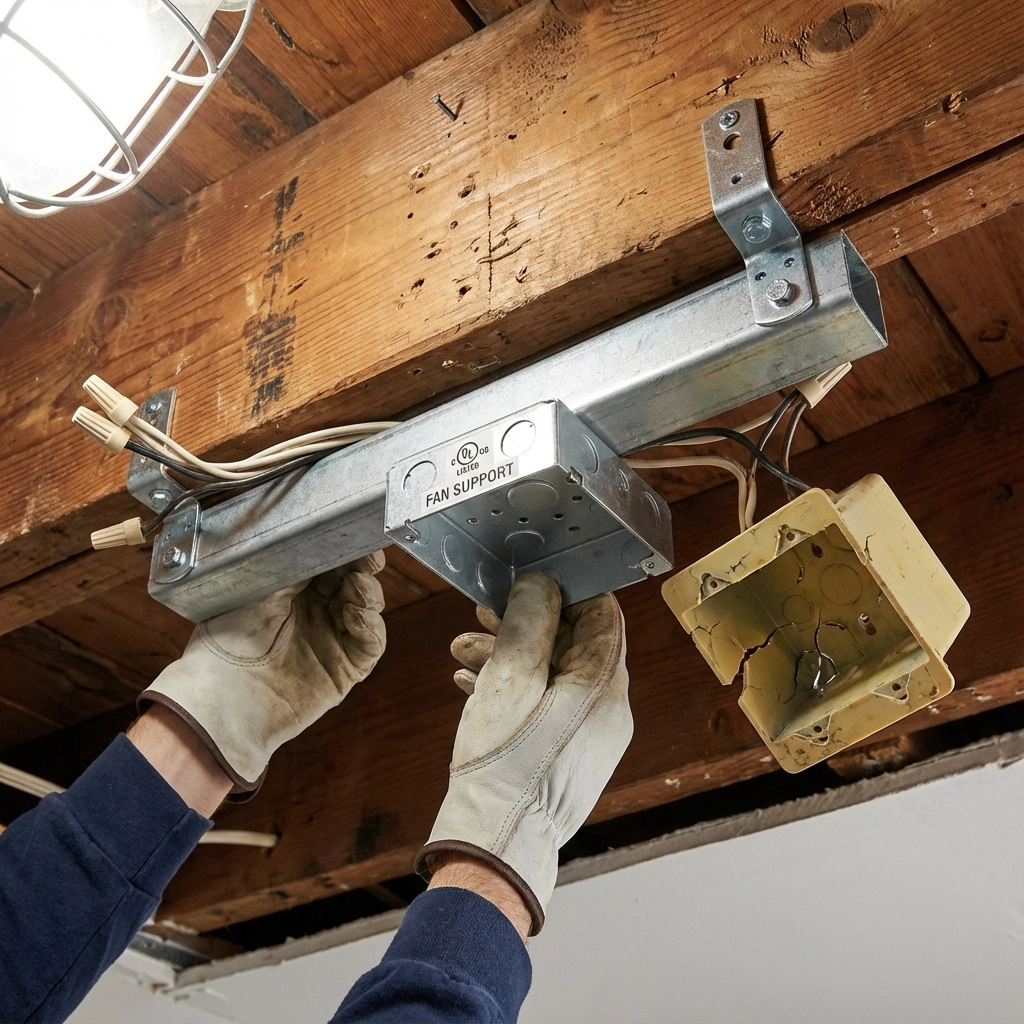
How electricians fix this: We always install a UL-listed electrical box specifically marked "suitable for ceiling fan support." For retrofit installations, we use a ceiling fan brace kit that anchors firmly between ceiling joists, distributing the weight properly across the ceiling structure.
Here's what that really means: We're not just screwing into drywall or hoping the old box holds. We're creating a mounting system that's engineered to handle the specific stresses a ceiling fan creates.
Mistake #2: Hanging Your Fan at the Wrong Height
Walk into most homes and you'll see ceiling fans mounted too low, too high, or positioned where they create turbulence instead of smooth airflow.
The problem isn't just comfort: it's safety and efficiency. A fan mounted too low becomes a head-bumping hazard. Mount it too high, and it won't move air effectively, forcing the motor to work harder and reducing its lifespan.
The height rule electricians follow: Fan blades should sit 7-9 feet from the floor and at least 18 inches from any wall. For rooms with high ceilings, we install a downrod to bring the fan into the optimal operating zone. For lower ceilings under 8 feet, we recommend flush-mount fans designed specifically for tight spaces.
What most people get wrong: They assume bigger is better, or they mount the fan as high as possible to "get it out of the way." Both approaches reduce the fan's effectiveness and can stress the motor.
Mistake #3: Ignoring Proper Electrical Connections
Here's where things get genuinely dangerous. Improper wiring isn't just about whether the fan works: it's about fire safety and electrical hazards that can develop over time.
Most homeowners see three wires and think they can figure it out. But ceiling fans often have separate circuits for the motor and lights, and the wiring requirements are more complex than a simple light fixture.
Common wiring mistakes we fix:
- Loose wire connections that create heat and fire risks
- Using the wrong wire gauge for the fan's electrical requirements
- Incorrectly connecting the neutral and ground wires
- Mixing up hot wires for fan and light controls
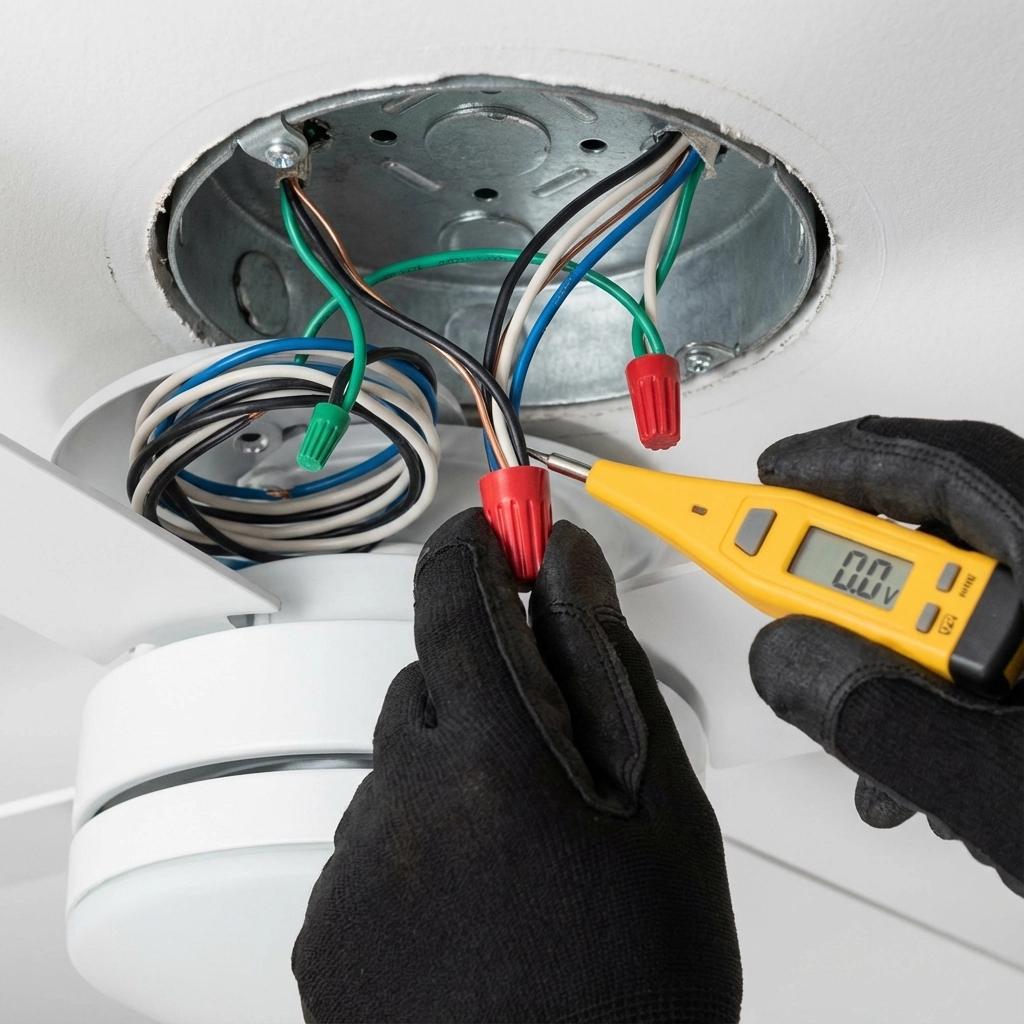
How we handle the electrical work: Before touching any wires, we turn off power at the circuit breaker: not just the wall switch. We test all connections with a voltage meter to confirm power is off. Then we follow the manufacturer's wiring diagram exactly, using proper wire connectors and ensuring all connections are secure.
The key insight: Each ceiling fan model has specific wiring requirements. What worked for your last fan might not work for this one.
Mistake #4: Choosing the Wrong Fan Size for Your Room
Most people either go too big (thinking bigger means better air circulation) or too small (trying to save money). Both approaches backfire.
An oversized fan in a small room creates turbulence and noise instead of comfortable airflow. An undersized fan in a large space provides inadequate circulation and forces the motor to work harder, reducing its lifespan.
The sizing guide we use:
- Rooms up to 75 square feet: 29-36 inch fan
- 75-144 square feet: 42-48 inch fan
- 144-225 square feet: 52-54 inch fan
- Larger than 225 square feet: 60+ inch fan or multiple fans
What homeowners often miss: Room layout matters as much as square footage. A long, narrow room might need two smaller fans rather than one large fan, regardless of the total square footage.
Mistake #5: Poor Blade Installation and Balancing
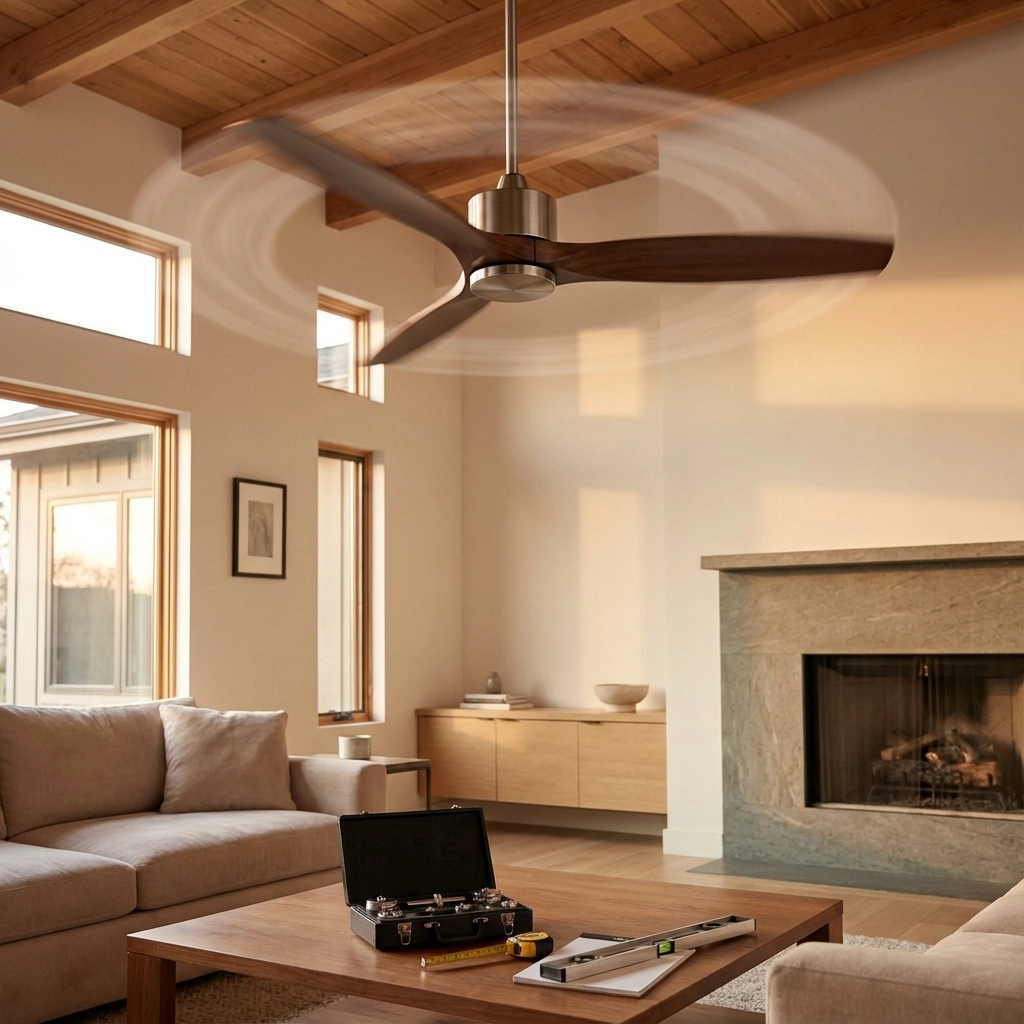
Even if you get everything else right, unbalanced or improperly installed blades will make your fan wobble, vibrate, and create noise that drives you crazy.
Most people assume blade wobble means the fan is defective. In reality, it's usually an installation issue that's completely fixable.
Common blade problems:
- Blades installed at different heights or angles
- Loose blade screws that allow movement during operation
- Warped blades or damaged mounting brackets
- Mismatched blade weights (especially with replacement blades)
Our balancing process: We measure each blade's height from the ceiling to ensure consistent spacing. We check all blade screws and brackets for tightness before the first test run. If wobble persists, we use a blade balancing kit with small weights to correct the spin.
The difference this makes: A properly balanced fan operates silently and smoothly, while an unbalanced fan creates noise and premature wear on the motor bearings.
Mistake #6: Skipping the Assembly Step
Here's a mistake that wastes time and creates unnecessary frustration: trying to assemble the fan while it's hanging from the ceiling.
Most people want to get the fan mounted as quickly as possible, so they hang the motor housing and then try to attach blades, lights, and other components while working overhead. This approach leads to dropped parts, incorrect assembly, and the need to take everything down and start over.
The professional approach: We completely assemble the fan on the ground first, including attaching blades and testing all electrical components. Only then do we mount it to the ceiling. This ensures everything fits properly and works correctly before it's permanently installed.
Why this matters: If there's a problem with the fan: defective parts, missing components, or assembly issues: it's much easier to fix on your workbench than while balancing on a ladder.
Mistake #7: Incorrect Switch Wiring and Controls
Many ceiling fans have separate controls for fan speed and lighting, but incorrect switch configuration leaves you with both features on the same circuit. This creates unnecessary energy consumption and removes the convenience of independent control.
What we see in Lawrenceville homes: Homeowners connecting both the fan motor and light kit to a single wall switch, then wondering why they can't control fan speed separately from the lights.
The proper setup: We install appropriate wall controls that match the fan's requirements: whether that's separate switches for fan and light, a combination control with multiple settings, or a remote control system that eliminates the need for special wall switches.
The Bottom Line
Ceiling fan installation involves more technical considerations than most homeowners realize. From electrical box requirements to proper wiring, correct sizing, and precise balancing, each step affects both safety and performance.
When you're dealing with electrical work, proper mounting systems, and moving parts that will operate for thousands of hours, small mistakes compound into bigger problems over time. The fan that seems fine today might develop wobbles, noise issues, or even safety hazards months later if the installation wasn't done correctly.
Professional electricians bring the knowledge, tools, and experience to handle these installations properly the first time. We understand the building codes, electrical requirements, and manufacturer specifications that ensure your ceiling fan operates safely and efficiently for years to come.
If you're experiencing issues with a recently installed ceiling fan: wobbling, noise, intermittent operation, or electrical problems: these installation mistakes might be the culprit. The good news is that most of these issues are fixable with the right expertise and approach.
Book Ceiling Fan Installation or Troubleshooting with Radiant Electric
If you're in Gwinnett County or anywhere in Metro Atlanta, our licensed and insured technicians can install your fan correctly or quickly diagnose that wobble, hum, or flicker.
- Transparent, upfront pricing
- Licensed and insured technicians
- Workmanship warranty on every ceiling fan job
- Serving Gwinnett County and the greater Metro Atlanta area
Schedule today at https://radiantelectricatl.com/ and get it done right the first time.