7 Mistakes You’re Making with Outdoor Lighting Installation in Gwinnett County (and How to Fix Them)
You’ve spent the weekend upgrading the landscaping at your home in Lawrenceville. The mulch is fresh, the hydrangeas are in, and the curb appeal is finally hitting its stride. But then the sun goes down, and your hard work disappears into the Georgia darkness. Naturally, your next thought is outdoor lighting.
It seems simple enough: buy a few box-store kits, stick them in the ground, and plug them in. However, we see the results of "quick fixes" all over Gwinnett County: from flickering path lights in Suwanee to tripped breakers in Snellville. At Radiant Electrical, we’ve been called out to fix dozens of these DIY attempts that went south.
This isn't about scaring anyone. If you want to tackle this yourself, we want you to do it right. But there’s a big difference between "lights that turn on" and a professional-grade system that survives a Gwinnett summer storm. Here are the seven most common mistakes homeowners make and, more importantly, how to fix them before they become a headache.
1. The "Airport Runway" Effect
We’ve all seen it: a perfectly straight line of path lights spaced exactly two feet apart along a walkway. It looks less like a welcoming home and more like a landing strip at Hartsfield-Jackson.
The Mistake: Most people think path lights need to be perfectly symmetrical and close together to be effective. In reality, this creates "hot spots" of bright light followed by deep shadows, which actually makes it harder for your eyes to adjust at night.
The Fix: Stagger your lights. Instead of a straight line, place them on alternating sides of the path. Focus on lighting the areas where the path changes direction or where there’s a potential trip hazard. You want a gentle wash of light, not a spotlight on every single brick.

2. Ignoring "Voltage Drop"
Imagine trying to water a massive garden with a 200-foot hose that has a tiny leak at every connection. By the time the water reaches the end, it’s just a trickle. This is exactly what happens with electricity in long lighting runs: it’s called voltage drop.
The Mistake: Homeowners often daisy-chain twelve lights onto one thin wire and wonder why the light closest to the house is blindingly bright while the one at the edge of the driveway looks like a dying firefly.
Here’s what that really means: The further electricity travels through a wire, the more "push" (voltage) it loses due to resistance. If the voltage drops too low, your LED bulbs won't just be dim; they’ll actually burn out faster because the internal components are struggling to operate.
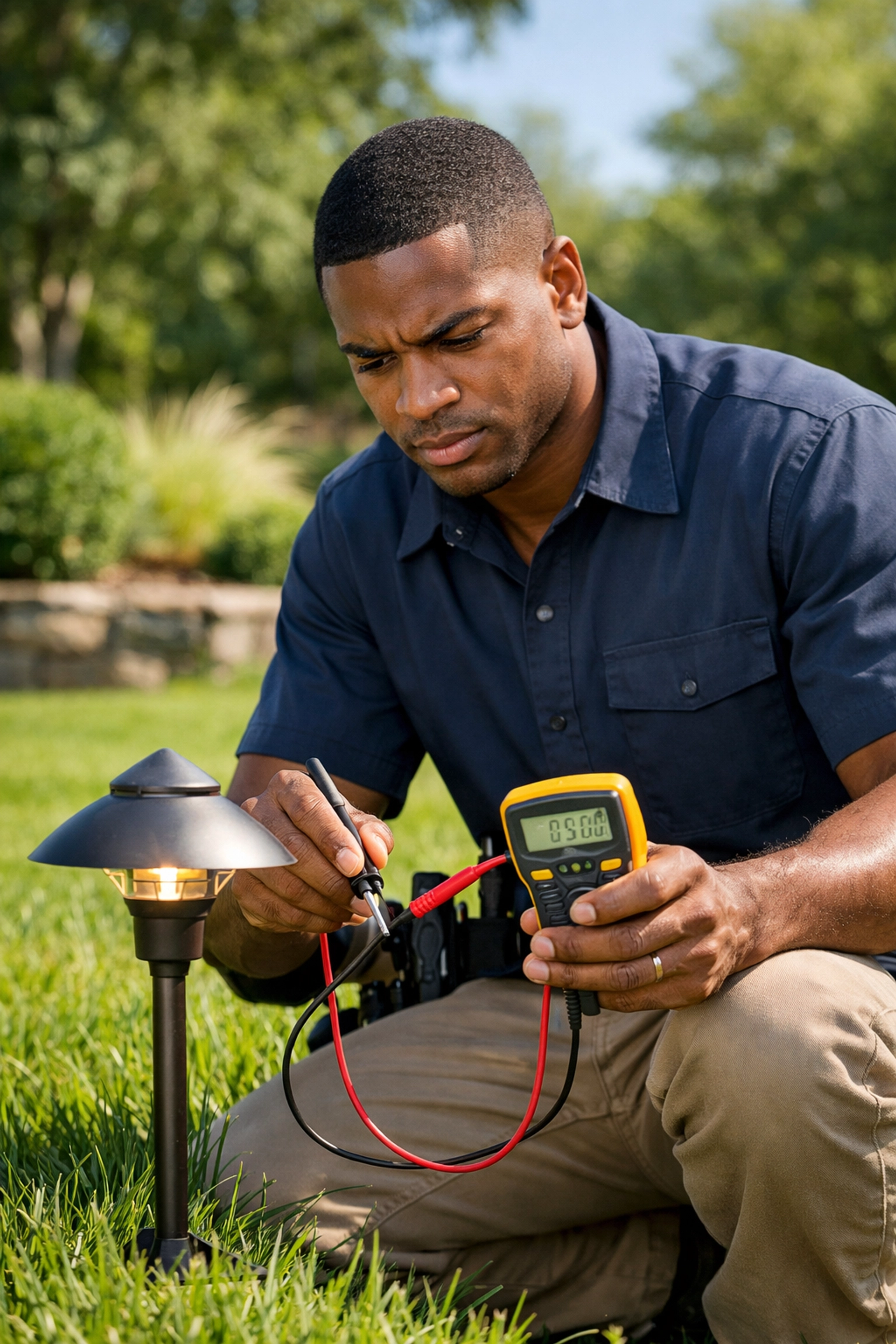
The Fix: Use a thicker gauge wire for longer runs and "center-tap" your layout. Instead of running one long line, run the wire to the middle of your light group and split it in two directions. At Radiant Electrical, we use specialized meters to ensure every fixture on your property receives the exact voltage it’s rated for.
3. Buying "Indoor" or Cheap Plastic Fixtures
The humidity in Gwinnett County is no joke. Between the July heat and the heavy spring rains, the outdoor environment is incredibly harsh on electrical components.
The Mistake: Using fixtures that aren't properly "wet-rated" or choosing cheap plastic models from big-box stores. Plastic becomes brittle under the Georgia sun and eventually cracks, allowing moisture to seep into the socket.
The Fix: Invest in solid brass or aircraft-grade aluminum fixtures. These materials dissipate heat better and won't corrode or crack. When you're looking for an electrician in Lawrenceville, GA, ask them about the "IP Rating" (Ingress Protection) of the fixtures they use. You want a high rating to ensure that dust and water stay out of the electrical bits.
4. Poor Transformer Placement and Sizing
The transformer is the "brain" of your outdoor lighting system. It takes the 120-volt power from your house and steps it down to a safe 12 volts for your yard.
The Mistake: Homeowners often hide the transformer in a crawlspace or a spot with zero airflow, or they buy a 100-watt transformer and try to pull 110 watts of power from it.
The Fix: Think of your transformer like a car engine. If you redline it constantly, it’s going to blow. We recommend the "80% Rule." If you have 80 watts of lights, use at least a 100-watt transformer. Also, ensure it’s mounted in a spot where it can breathe. If you're unsure about your power capacity, it's worth checking out our guide for Gwinnett County electrical services to see if your current exterior outlets can handle the load.
5. Forgetting About the GFCI
Safety is the one area where we never compromise. Since outdoor lighting involves electricity and wet ground, the risk of a short circuit is real.
The Mistake: Plugging a professional-grade lighting system into a standard, non-protected outlet. Most people believe that a standard circuit breaker in the garage is enough. It isn’t.
Here’s what that really means: A GFCI (Ground Fault Circuit Interrupter) is a fast-acting circuit breaker designed to shut off electric power in the event of a ground-fault in as little as 1/40th of a second. It works by comparing the amount of current going to and returning from equipment along the circuit conductors. If the "flow" is uneven: meaning electricity is escaping (perhaps through a person or wet mulch): it cuts the power instantly.
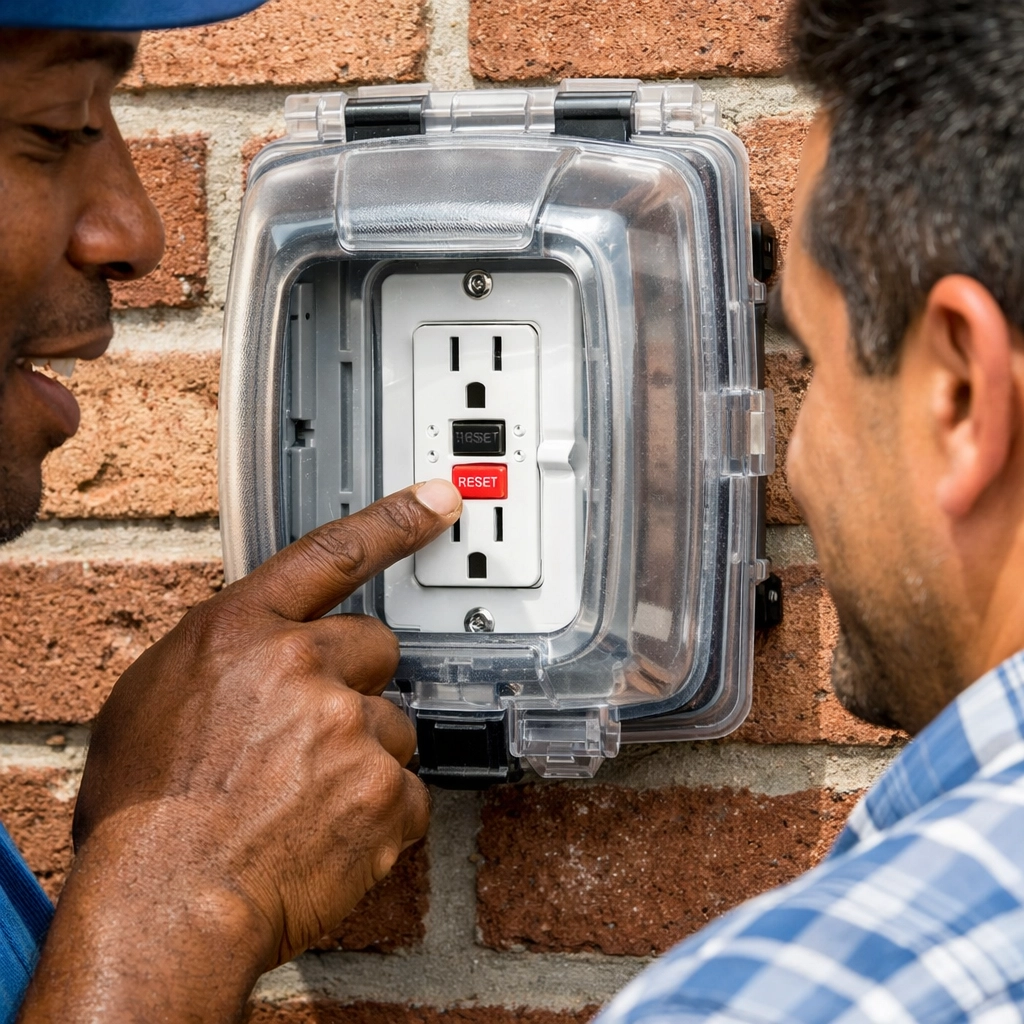
The Fix: Ensure your outdoor lighting is plugged into a dedicated GFCI outlet with an "In-Use" weather cover. If your exterior outlets are old and keep tripping, you might need a 24/7 emergency electrician to diagnose if it’s a faulty outlet or a deeper wiring issue.

6. Blind Spot: Light Pollution and Glare
Have you ever walked past a house and felt like you were being interrogated by a floodlight? That’s glare, and it’s a hallmark of a bad installation.
The Mistake: Aiming lights directly at eye level or into a neighbor’s window. This is especially common in tightly packed neighborhoods in Duluth or Norcross.
The Fix: Use "aim-able" fixtures with shields (often called "shrouds" or "glare guards"). The goal is to see the effect of the light: the glow on the tree trunk or the wash on the stone wall: not the light bulb itself. Think of it like a theater; you want to see the stage, not the spotlights hanging from the ceiling.
7. Shallow Wiring Depth
In Georgia, we have that famous red clay. It’s tough to dig in, which leads many DIYers to bury their lighting wires only an inch or two under the mulch.
The Mistake: Shallow wires are a disaster waiting to happen. The first time someone uses an edger, a shovel, or even a heavy-duty rake, those wires are getting sliced.
The Fix: Code usually requires low-voltage wiring to be buried at least 6 inches deep. While that sounds like a chore in Gwinnett clay, it’s the only way to protect your investment. At Radiant Electrical, we use specialized trenching tools that tuck the wire deep enough to stay safe from lawn maintenance but without destroying your grass.
Why Professional Installation Matters in Gwinnett
Gwinnett County has specific codes when it comes to electrical work. Inspectors often look at outdoor lighting during the final stages of home construction or major renovations to ensure everything is up to safety standards.
When Marcus, a homeowner in Snellville, tried to install his own high-end LED system, he didn't realize that his backyard outlets weren't properly grounded. After the first big spring thunderstorm, his entire system fried: nearly $1,200 in fixtures gone in an instant. When Radiant Electrical arrived, we found that a simple $20 grounding fix could have saved the whole thing.
Takeaway: A great outdoor lighting setup should make your home safer and more beautiful, not give you a new list of chores. If you're ready to stop guessing and start glowing, check out our full range of services.
Quick Summary for the Gwinnett Homeowner:
- Stagger your lights: Avoid the runway look.
- Calculate your load: Don't max out your transformer.
- Quality over price: Brass beats plastic every time.
- Safety first: Always use GFCI protection.
- Dig deep: 6 inches of depth keeps wires safe from the lawnmower.
Whether you are in Marietta or right here in Lawrenceville, we're here to make sure your home shines the right way. Don't let a "simple" DIY project turn into an electrical hazard. Let's get it done right the first time.