Do You Really Need a Panel Upgrade for an EV Charger? Here’s the Truth for Atlanta Drivers
You finally did it. After months of researching ranges, test-driving different models, and checking out the tax credits, you’ve got a brand-new electric vehicle sitting in your driveway in Cascade Heights or parked in your garage in Marietta. It’s sleek, it’s quiet, and it’s the future. But then comes the moment of truth: you realize that charging it using a standard wall outlet is like trying to fill a swimming pool with a cocktail straw.
You start looking into ev charger installation atlanta, and almost immediately, you hear the dreaded phrase: "You’re going to need a full electrical panel upgrade."
Suddenly, your exciting transition to green energy feels like it just hit a $3,000 speed bump. But before you stress out, let’s clear the air. At Radiant Electrical, we’ve seen hundreds of homes across Metro Atlanta, and the truth is more nuanced than a simple "yes" or "no." This isn't about scaring anyone into buying equipment they don't need; it's about making sure your home can handle your new car safely and efficiently.
The Big Question: Is Your "Bucket" Full?
Think of your home’s electrical panel as a giant bucket. Every time you turn on the AC, run the dryer, or start the dishwasher, you’re pouring water out of that bucket. Your utility company (like Georgia Power) keeps the bucket filled to a certain level: this is your "amperage."
Most modern homes in the Atlanta area have a 200-amp panel. For a typical family, that’s a pretty big bucket. However, adding a Level 2 EV charger is like adding a massive fire hose to the mix. It pulls a lot of "water" (electricity) all at once.
The question isn't just "Do I have a 200-amp panel?" The real question is: "How much is left in the bucket when everything else is running?"
Many homeowners believe that if they have a 200-amp panel, they are automatically "good to go." While that’s often true, it’s not a guarantee. On the flip side, people with 100-amp panels often think they are doomed to an expensive electrical panel upgrade atlanta process. Surprisingly, that isn't always the case either.

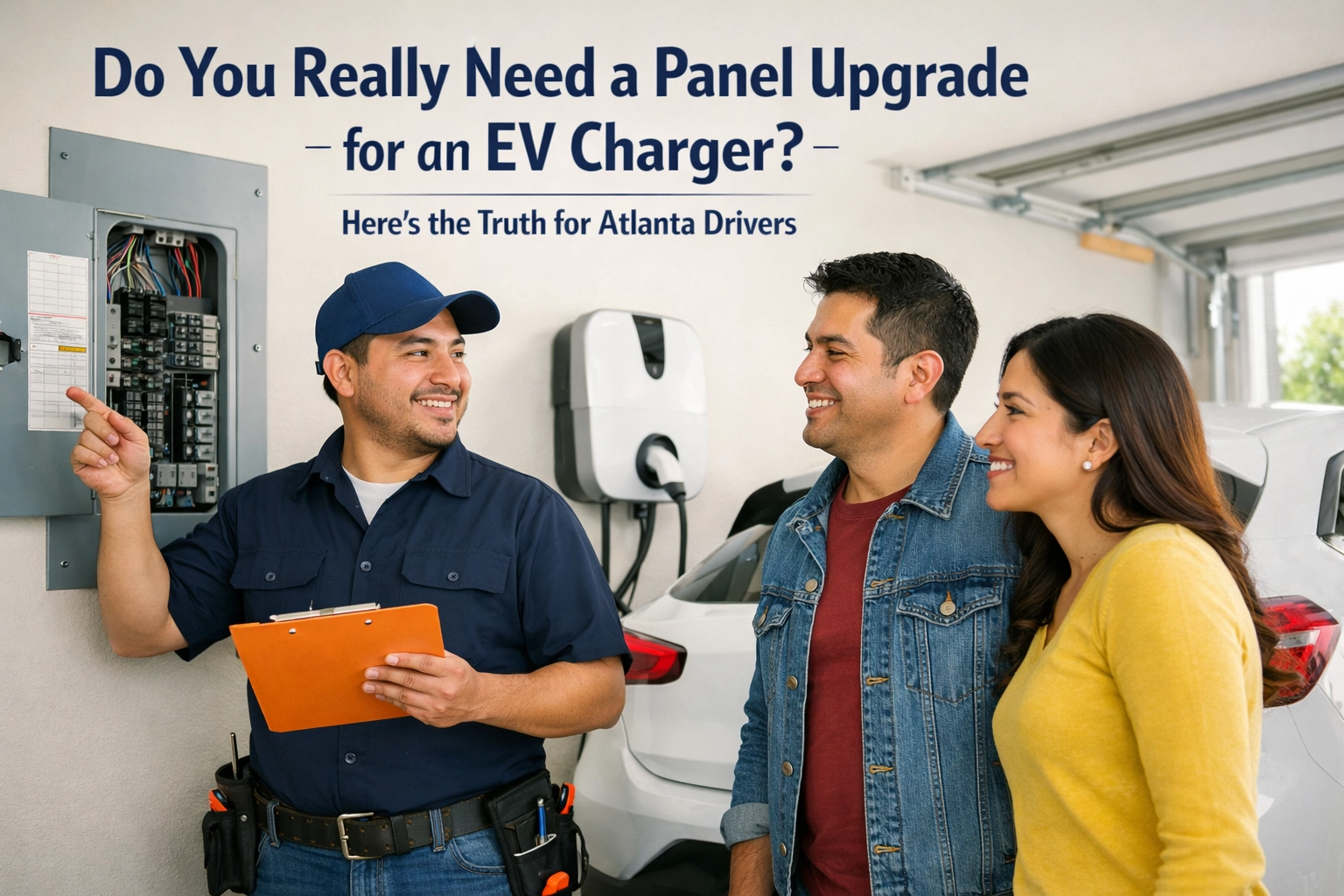
A Radiant Electrical technician, an expert African American electrician, walks a Mexican-American homeowner through a load calculation in their Gwinnett County garage.
Why a "Load Calculation" is Your Best Friend
Before any wires are pulled, a professional needs to perform a load calculation. Here’s what that really means: we sit down and add up the power requirements of every major appliance in your home. We look at your HVAC system, your electric oven, your water heater, and even your microwave.
We don't just guess. We use a formula defined by the National Electrical Code (NEC) to determine the "demand factor." We want to make sure that on the hottest July day in Atlanta: when your AC is screaming, you’re doing three loads of laundry, and you plug in your car: your main breaker doesn't trip and leave you sitting in the dark.
If your load calculation shows that your home’s peak demand stays below 80% of your panel’s capacity, you likely don't need an upgrade. If you’re pushing 90% or higher, we need to talk about options.
Signals That an Upgrade is Non-Negotiable
While we try to avoid unnecessary upgrades, there are some "hard stops" where Radiant Electrical will insist on a panel change for safety reasons. These aren't just suggestions; they are warnings that your current system is at its limit or is fundamentally unsafe.
1. The 60-Amp Service
If you live in an older home in neighborhoods like West End or parts of Decatur, you might still have 60-amp service. In 2026, this is simply not enough for modern life, let alone an EV. Trying to run a Level 2 charger on a 60-amp panel is like trying to run a marathon while breathing through a straw. It’s a fire hazard, and it’s the most common reason for a mandatory electrical panel upgrade atlanta.
2. "Zombie" Panels (Federal Pacific and Zinsco)
If you open your panel door and see the names Federal Pacific (FPE) or Zinsco, you’re looking at a safety risk. These brands were popular decades ago but are now known for a critical flaw: the breakers often fail to trip when there’s a surge. Instead of cutting the power, they stay "on," allowing the wires to heat up like a stovetop coil inside your walls. We won't install an EV charger on these panels because adding that much load to a known faulty system is a recipe for disaster.
3. Physical Warning Signs
If you notice flickering lights when the dryer starts, or if you hear a faint buzzing or see "scorch marks" (little black or brown burns) near your breakers, these are signals. Your panel is telling you it’s tired. Adding an EV charger to a panel that is already struggling is like asking a person with a broken leg to carry a heavy backpack.

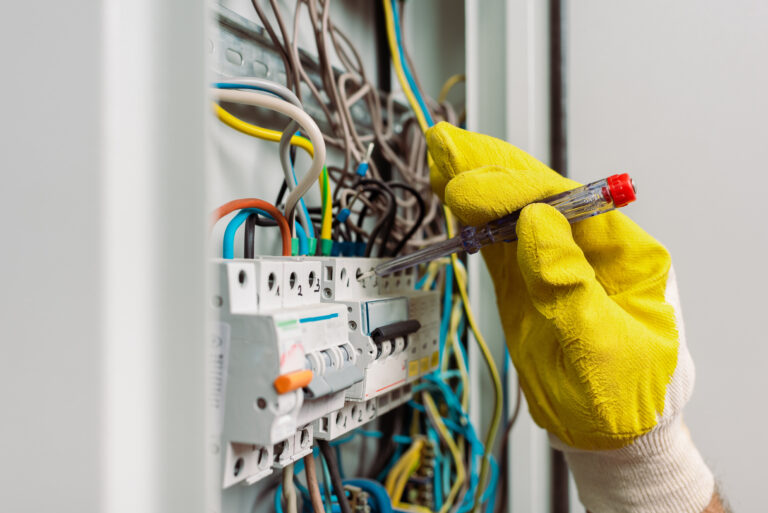
Close-up of a clean, professionally installed 200-amp electrical panel by Radiant Electrical, showing clear labeling and organized wiring.
The "Smart" Alternative: Load Management
What if your panel is at capacity, but you really don't want to spend the money on a full upgrade? This is where technology has caught up.
There are devices called "Smart Load Managers" or "EV Energy Management Systems." Here’s what that really means: it’s a traffic cop for your electricity.
Imagine your car wants to charge, but your AC and Electric Dryer are both running. The load manager tells the car, "Wait your turn." Once the dryer finishes, the "traffic cop" opens the lane, and the car starts charging. This allows you to stay within your current panel’s limits without overloading it. For many Atlanta drivers, this is a cost-effective way to handle ev charger installation atlanta without tearing out the whole panel.
The Atlanta Heat Factor
We have to talk about our local climate. Atlanta summers are brutal on electrical systems. Heat increases resistance in wires. When resistance goes up, wires get even hotter. If your panel is located in a hot garage or on the sunny side of your house, it’s already working under stress.
A panel that works fine in the winter might start tripping in August. When we evaluate your home, we aren't just thinking about today; we’re thinking about those 95-degree afternoons when every house on the block is pulling max power from the grid.

A realistic photo of a diverse family in their driveway next to their new EV, showing a professional charger installation on the exterior wall.
Real Talk: What to Expect During Installation
When Radiant Electrical arrives at your home, our goal is to be in and out with as little disruption as possible. If you do need an upgrade, here is a quick look at the process:
- Permitting: We handle the paperwork with the city or county.
- Coordination: We coordinate with Georgia Power or your local EMC to pull the meter and shut off power temporarily.
- The Swap: We remove the old "bucket" and install the new, larger one. You can see an example of a recent electrical panel upgrade and rewiring project in metro Atlanta to see the level of detail we put into our work.
- Labeling: We label every single breaker so you actually know which switch controls the kitchen and which one controls the charger. No more guessing games.
Most panel upgrades are completed in a single day. You might be without power for a few hours, but by dinner time, your home will be safer and ready for the future.
Common Misconceptions Directly Addressed
"I have a new house, so I’m definitely fine."
Not necessarily. Builders often install the bare minimum required by code. If you’ve added a hot tub, a finished basement, or a high-end workshop, you might be closer to your limit than you think.
"I'll just use the 120V plug; it's cheaper."
While true, "Level 1" charging only adds about 3-5 miles of range per hour. If you commute from Gwinnett to Downtown Atlanta every day, you won't be able to recover your battery overnight. Level 2 is the standard for a reason.
"Any electrician can do this."
Electrical codes change. In 2026, the rules for grounding and circuit protection for EVs are specific. You want someone who specializes in ev charger installation atlanta to ensure your warranty remains valid and your insurance company is happy.

An African American Radiant Electrical pro uses a thermal camera to check for hot spots in an older panel, explaining the findings to a homeowner.
Your Next Steps
Don't let the fear of a panel upgrade stop you from enjoying your EV. Most of the time, we can find a solution that fits your budget and your home's capacity.
If you're ready to get a real answer: not a sales pitch: reach out to Radiant Electrical. We’ll perform a proper load calculation and give you the straight truth. Whether it's a simple charger install or a necessary electrical panel upgrade atlanta, we’ll make sure it’s done right the first time.
Key Takeaways:
- Don't assume: A 200-amp panel doesn't guarantee capacity, and a 100-amp panel doesn't always mean you're stuck.
- Safety first: If you have an FPE or Zinsco panel, upgrade it regardless of the EV.
- Options exist: Smart load management can often save you from a full panel replacement.
- Professionalism matters: Get a documented load calculation before you spend a dime.
Your car is ready for the road. Let's make sure your home is ready for your car.

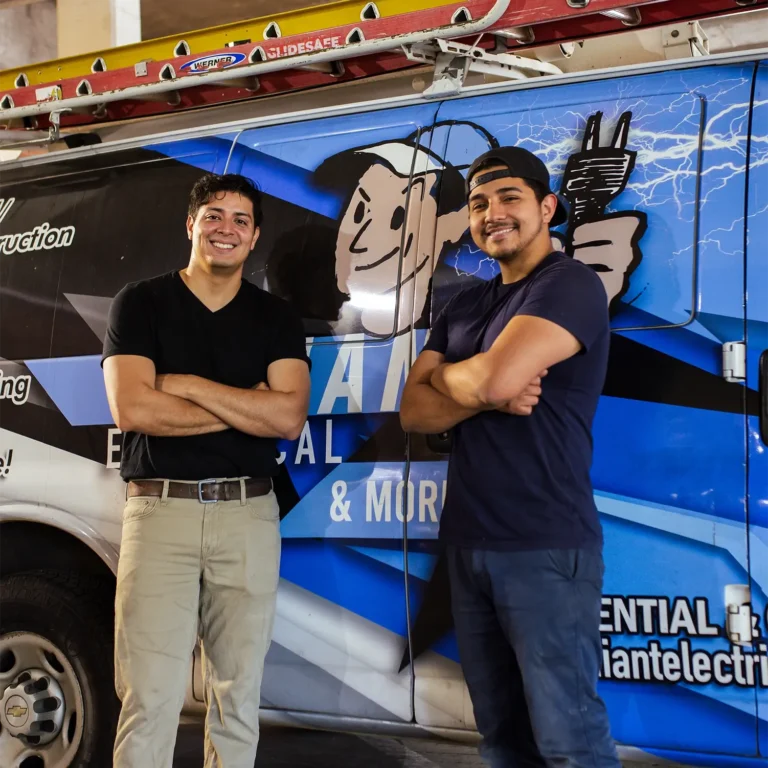
The Radiant Electrical team truck parked in a leafy Atlanta suburb, symbolizing reliable, local service for the community.