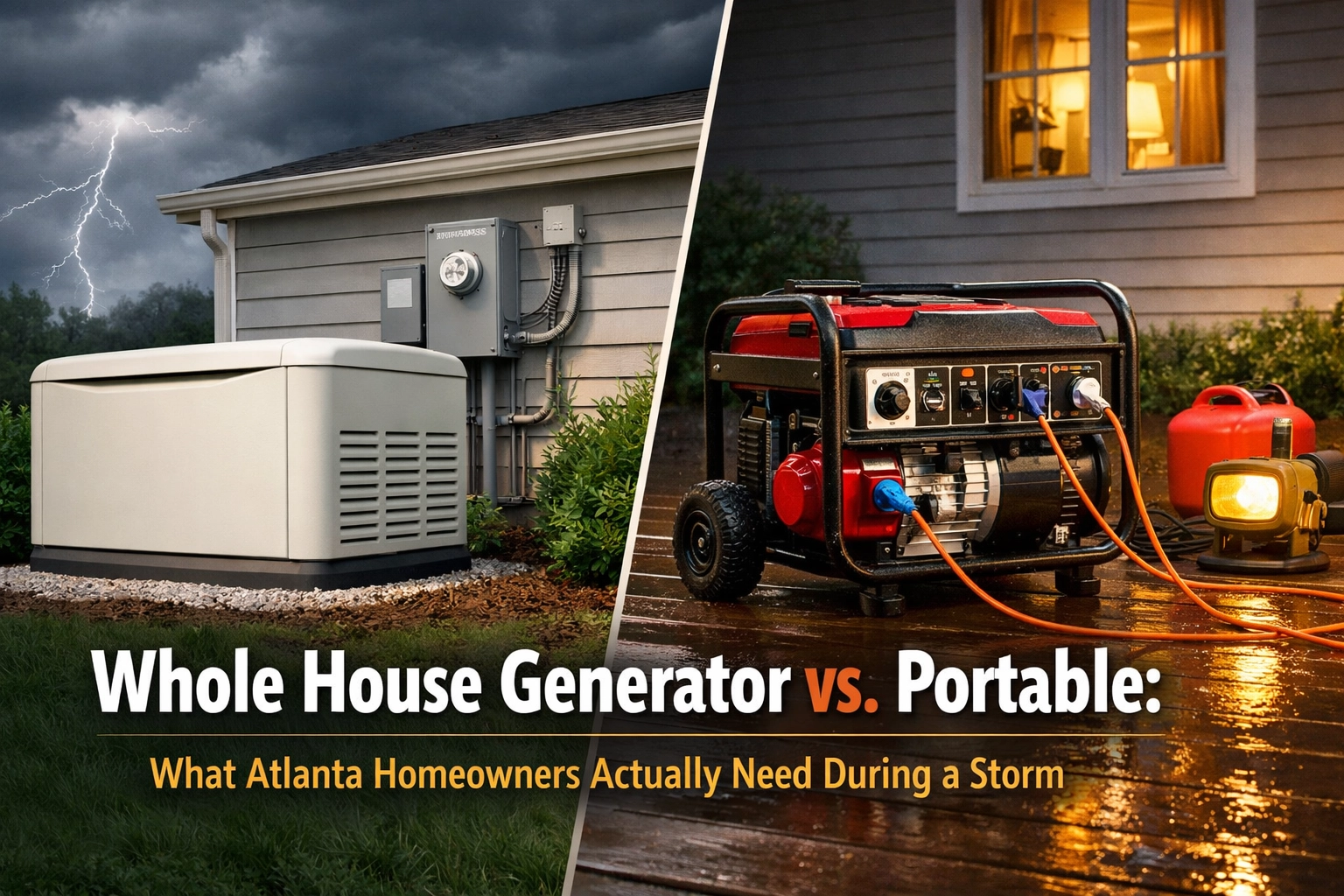
Whole House Generator vs. Portable: What Atlanta Homeowners Actually Need During a Storm
Picture this: It's 2 AM, severe thunderstorms are rolling through Metro Atlanta, and suddenly your power cuts out. Your phone's nearly dead. The fridge is already warming up. And if you've got a portable generator, you're now fumbling in the dark trying to drag it out of the garage, find extension cords, and figure out which appliances to prioritize, all while lightning's still cracking overhead.
Now imagine instead that the lights flicker for maybe ten seconds, then come right back on. You didn't touch a thing. That's the difference between a whole-house generator and a portable unit, and it's a decision more Atlanta homeowners are wrestling with every storm season.
The Real Story Behind Generator Options
Most people think generators are pretty straightforward, you either spend a fortune on the fancy automatic kind or grab a cheaper portable one from Home Depot. But there's actually a lot more nuance here, especially when you're dealing with Georgia's unpredictable weather patterns.
A whole house generator atlanta system is basically a permanent fixture installed outside your home, connected directly to your natural gas line or propane tank. When the power goes out, a transfer switch detects it and signals the generator to kick on automatically, usually within 10-20 seconds. You're powering your entire home (or at least all your essential circuits) without lifting a finger.
Portable generators are exactly what they sound like, wheeled units you roll out, fuel up with gasoline, and connect to appliances via extension cords or a manual transfer switch. They're cheaper upfront but require you to actually be home and physically set them up when storms hit.

What Actually Happens During Metro Atlanta Storms
Here's what matters during real storm situations: when the power goes out, it rarely comes back in an hour. According to Georgia Power's outage data, severe weather events can leave homes without electricity for days, sometimes over a week during major storms like ice events or tropical systems.
During those extended outages, you're not just dealing with inconvenience. You're dealing with:
- Food spoilage after 4-6 hours without refrigeration
- Heating or cooling loss during extreme temperatures (remember, Atlanta gets both sweltering summers and occasional hard freezes)
- Sump pump failure leading to basement flooding
- Medical device power loss for anyone dependent on CPAP machines, oxygen concentrators, or refrigerated medications
- Security system failure when you might be away from home
A whole-house generator handles all of this automatically. A portable generator requires you to prioritize what gets power and constantly refuel every 8-12 hours at most.
The Portable Generator Reality Check
Portable generators typically produce between 3,000 and 8,500 watts. Here's what that really means in practical terms:
A standard refrigerator needs about 700 watts running (but 2,200 watts to start up). Your window AC unit? Around 1,200 watts. A space heater pulls 1,500 watts. A sump pump needs 1,300-2,150 watts. Add those up and you're already making tough choices about what stays on.
And here's the part nobody likes talking about: You're refueling these things every few hours during an outage. That means you need to stockpile gasoline (which has storage and safety issues), you need to be physically present to refuel, and you're doing this in potentially dangerous weather conditions. During a multi-day outage, you could be refueling 4-6 times per day.

Portable generators also require manual setup. When the power cuts at 2 AM during a storm, you're going outside in the dark and rain to haul the unit out, get it running, and connect everything. If you're away from home when the outage happens? Your food spoils, your basement might flood, and temperature-sensitive situations go unmanaged.
The American Red Cross generator safety guidelines emphasize that portable generators must be operated at least 20 feet from your home due to carbon monoxide risks. That means longer extension cords, more connection points, and more things that can go wrong.
The Whole-House Generator Advantage
A professionally installed whole-house system typically provides 10,000 to 22,000 watts or more, enough to power your entire home's essential systems simultaneously. Here's what automatic operation actually means: The generator monitors your power supply constantly. The moment utility power fails, a transfer switch disconnects your home from the grid and signals the generator to start. Within 10-20 seconds, your power's back on.
You don't touch anything. You don't go outside. You don't make decisions about what to power. The system just works.
These units run on your natural gas line (if you have one) or a large propane tank, which means they can run indefinitely without refueling. During a week-long outage, you never have to worry about fuel supplies or manual refueling in dangerous conditions.
When you're working with a qualified emergency electrician Atlanta team for installation, they're also setting up a transfer switch that's permanently wired into your electrical panel. This switch does two critical things: it safely disconnects you from the utility grid (preventing backfeed that could injure line workers) and manages which circuits get generator power during an outage.

The maintenance is straightforward, most whole-house units self-test weekly and need professional servicing about once a year. Compare that to portable generators, which need oil changes, fuel stabilizer management, and regular exercise runs to stay operational.
The Money Conversation Nobody Wants to Have
Let's be straight about costs. A whole-house generator installation typically runs $5,000 to $15,000 depending on size and your home's specific setup. That's not pocket change.
Portable generators cost $500 to $2,500 for decent units. Big difference, right?
But here's the full picture: With a portable unit, you're also buying:
- Extension cords or manual transfer switch installation ($500-$1,500)
- Fuel storage containers and stabilizers
- Replacement gasoline every few months if stored
- More frequent maintenance and shorter equipment lifespan
- The labor and inconvenience of manual operation
More importantly, you're accepting the limitations, partial power coverage, manual operation, and the real possibility that you won't be home when the outage happens.
A whole-house generator is essentially power insurance. You're paying upfront for the certainty that your home stays protected regardless of when outages occur or whether you're present.
What Actually Makes Sense for Atlanta Homes
If you're in an area that loses power once every few years for a few hours, a portable generator probably makes sense. You can manage the inconvenience for short periods.
But if you're dealing with:
- Frequent storm-related outages (common in heavily wooded neighborhoods)
- Critical power needs (medical equipment, home-based businesses, elderly family members)
- Extended travel periods where your home needs protection while you're away
- High-value food storage (that restaurant-quality wine collection or full chest freezers)
- Basement flooding risks requiring sump pump operation
Then a whole-house system isn't really a luxury, it's practical protection.
According to NOAA's National Weather Service, Metro Atlanta averages 40-50 thunderstorm days annually, with severe storms increasing in frequency. When those storms knock out power for extended periods, automatic backup power stops being a nice-to-have and starts being essential infrastructure.
Installation and Safety Considerations
This isn't a DIY situation for either option, well, technically you can set up a portable generator yourself, but the transfer switch installation needs professional handling. For whole-house systems, you're absolutely looking at professional installation from start to finish.
A proper generator installation involves:
- Electrical panel assessment and transfer switch installation
- Generator pad or mounting platform (concrete or composite)
- Gas line or propane tank connection
- Permit acquisition and inspection compliance
- System testing and homeowner training
The entire process typically takes 1-2 days, and you're looking at permits, inspections, and coordination with your gas utility if you're tapping into natural gas service.
Portable generators are simpler to get running but come with serious safety requirements. Carbon monoxide poisoning kills dozens of people every year during power outages: always operate portable generators at least 20 feet from your home with exhaust directed away from windows and doors.
Making Your Decision
Here's the bottom line: Portable generators work for occasional, short-term outages when you're home to operate them. They're budget-friendly and relatively simple.
Whole-house generators make sense when you need reliable, automatic backup power regardless of when outages occur or whether you're present. They're expensive upfront but provide comprehensive protection and peace of mind.
For most Atlanta homeowners dealing with increasingly severe weather patterns, the question isn't really whether backup power is necessary: it's whether you want to manage that backup manually every time the lights go out, or whether you want a system that just handles it automatically while you sleep through the storm.
Neither option is wrong. But understanding what you're actually getting: and what you're giving up: makes the decision a whole lot clearer when the next severe weather warning hits your phone.