Marietta’s Midnight Mystery: Why Your Breakers Only Trip During a Thunderstorm
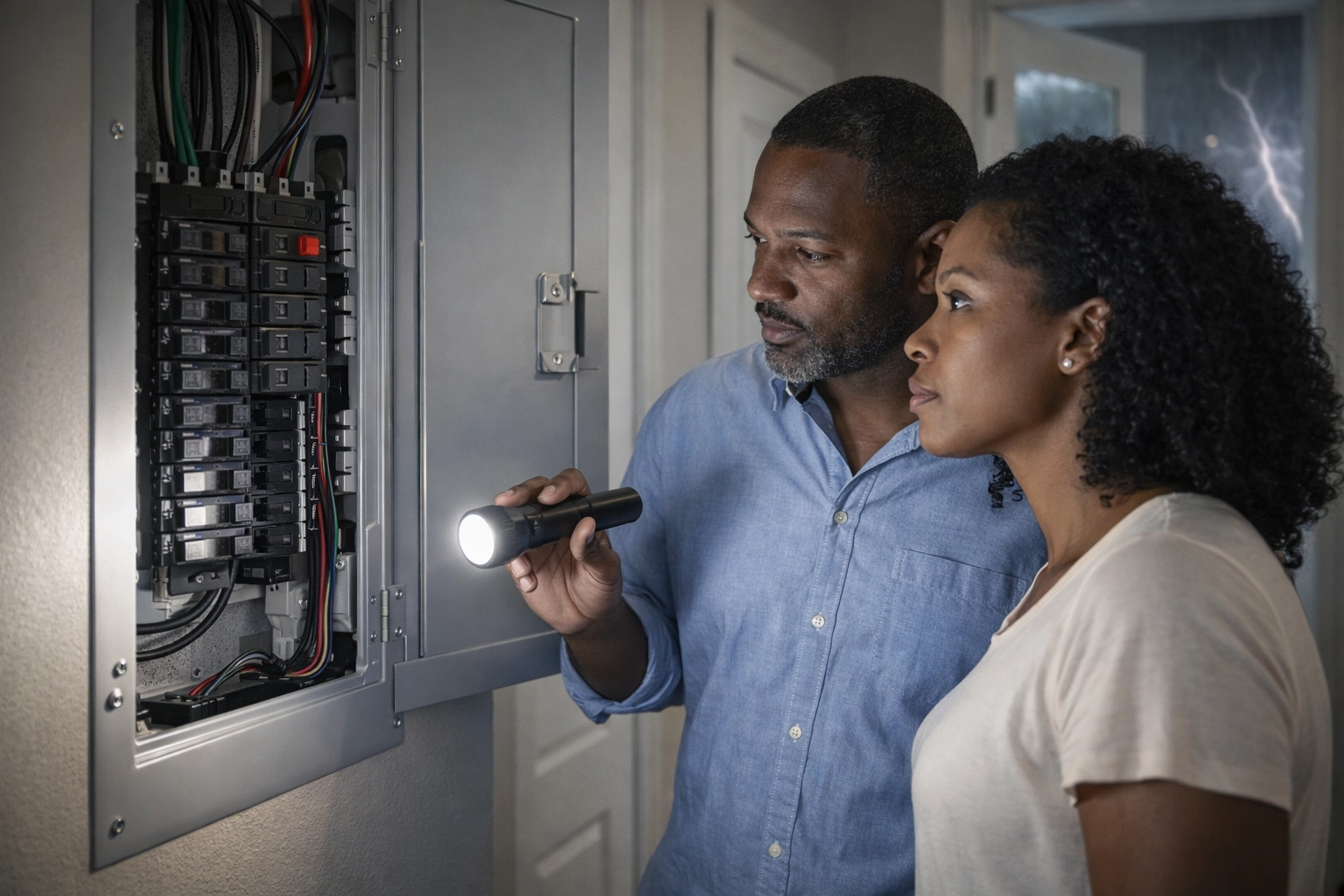
It is 2:00 AM in Marietta, Georgia. Outside, a classic Southern thunderstorm is rolling through, lighting up the sky over Kennesaw Mountain. Inside, Marcus and Tasha are fast asleep until a sudden crack of thunder is followed by a distinct click from the hallway. Suddenly, the white noise machine dies, the ceiling fan slows to a stop, and the house plunges into total darkness.
Marcus grabs a flashlight and heads to the garage, sighs, and flips the heavy plastic switch on the gray metal box back to "ON." Everything hums back to life: until the next lightning strike ten minutes later, and the whole cycle repeats.
If this sounds familiar, you aren't alone. Homeowners across Cobb County frequently report that their circuit breakers seem to have a personal vendetta against stormy weather. But here’s the thing: this isn’t a mystery, and it isn’t a ghost in the machine. It is your home’s electrical system doing exactly what it was designed to do: protecting you from something much worse than a dark room.
Before we dive into the technical details, it is important to establish one thing: this isn't about scaring anyone. Electrical issues can feel overwhelming, but understanding why your home reacts to a storm is the first step toward a safer, more reliable house. At Radiant Electrical, we believe an educated homeowner is a safe homeowner.
The Invisible Force: Electromagnetic Induction
Most people think a breaker trips during a storm because lightning physically struck their house. While direct strikes do happen, they are actually quite rare. If lightning hit your home directly, a tripped breaker would be the least of your concerns.
Instead, most "midnight mysteries" are caused by something called electromagnetic induction.
Think of your home’s wiring like a series of garden hoses. Under normal conditions, water (electricity) flows through them at a steady, controlled pressure. When lightning strikes nearby: perhaps hitting a utility pole a few streets over or even just striking the ground: it creates a massive, instantaneous burst of energy. This burst creates an electromagnetic field that can "push" extra electricity into any nearby wires, including the ones inside your walls.
Suddenly, that "garden hose" has ten times more pressure than it can handle. The circuit breaker senses this "surge" and snaps shut to prevent the wires from overheating. Here’s what that really means: The breaker is acting like a physical dam, stopping the flood of electricity before it can melt the insulation on your wires or fry your expensive 4K television.
If you’re noticing frequent trips during storms, it’s a sign that your system is sensitive to these external surges. This is often a cue to consult a professional electrician Marietta residents trust to evaluate your home's surge readiness.

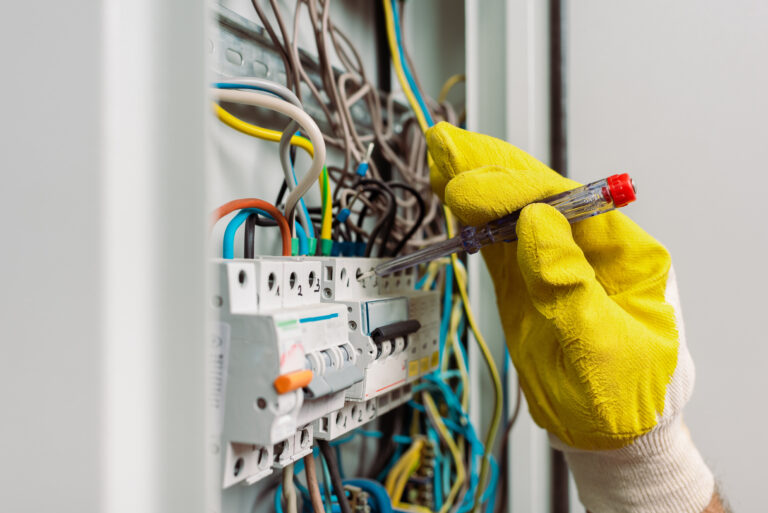
(Suggested Image: A Mexican homeowner reviewing a labeled circuit breaker panel in a bright, realistic residential setting.)
The Water Bridge: Moisture and Ground Faults
While lightning is the flashier culprit, rain is often the real saboteur. Thunderstorms in Georgia aren't just loud; they are incredibly wet. Heavy, wind-driven rain has a way of finding its way into places it doesn't belong.
Electrical systems and water are natural enemies. When water gets into an outdoor outlet, a porch light fixture, or even a crack in your home’s exterior siding where the main power line enters, it creates a "bridge." Electricity, which always looks for the easiest path to the ground, will jump across that water bridge. This is known as a ground fault.
Most modern homes are equipped with GFCI (Ground Fault Circuit Interrupter) outlets or breakers. These are incredibly sensitive. They can detect a "leak" in electricity as small as 5 milliamps: that’s less than the energy it takes to light a single LED on a Christmas string. When rain infiltrates a poorly sealed outdoor outlet near your patio, the GFCI detects the leak and trips the breaker instantly to prevent a fire or a shock hazard.
Many homeowners often believe that if an outlet is covered, it’s safe. However, over time, the rubber gaskets on outdoor "bubble covers" can dry out and crack. If your breakers are tripping during heavy rain even without lightning, it’s a strong signal that moisture is breaching your defenses.
Why You Should Stop the "Reset Habit"
When a breaker trips, our instinct is to go to the panel and flip it back immediately. If it trips again, we flip it again. We call this the "reset habit," and it’s a behavior we want to help you break.
Think of a tripped breaker like a smoke alarm. If your smoke alarm goes off, you don't just take the batteries out so you can finish your movie; you look for the fire. A breaker that trips repeatedly during a storm is trying to tell you that something is wrong.
Repeatedly resetting a breaker that is reacting to a surge or a ground fault can actually damage the breaker itself. Inside the breaker is a small mechanical linkage and a bi-metallic strip. Every time it trips, it undergoes physical stress. If you force it to reset while a fault is still present, you risk "welding" the internal components together. If that happens, the breaker may fail to trip the next time there is a real emergency, which is how electrical fires start.
Instead of fighting the breaker, take it as a warning. If a specific circuit: like the one powering your outdoor lights or your garage: trips every time it rains, leave it off until the storm passes and you can have a qualified electricians Marietta GA expert take a look.
The Whole-House Shield: Surge Protection
If you want to move from reacting to storms to actually preventing the "midnight mystery," the answer usually lies in a Whole-House Surge Protective Device (SPD).
Many people rely on those power strips you buy at big-box stores. While those are fine for a lamp or a clock radio, they are "point-of-use" devices. They are like trying to stop a flood at your front door with a single towel. A whole-house surge protector is installed directly into your main electrical panel. It acts as a gatekeeper for your entire home.
When a lightning-induced surge tries to enter your home through the utility lines, the SPD detects it in nanoseconds and diverts the excess energy safely into the ground before it ever reaches your breakers or your appliances.
For Marietta homeowners, this is especially critical because of how much technology we now have in our homes. From "smart" refrigerators to EV chargers, our modern appliances are filled with delicate microchips that are much more sensitive to surges than the appliances of twenty years ago. You can learn more about modern standards by checking if your home meets the latest Georgia electrical codes.

(Suggested Image: An African American homeowner and electrician reviewing a whole-house surge protector at a clean, organized panel—professional and approachable.)
Check Your Grounding
One of the most overlooked reasons for storm-related electrical issues is poor grounding. Every electrical system needs a way to "bleed off" excess energy into the earth. This is typically done through a copper rod driven deep into the ground outside your home, connected to your main panel.
In older Marietta neighborhoods, these grounding rods can sometimes become disconnected, or the soil can pull away from them during dry spells, making them less effective when a storm finally hits. If your home isn't properly grounded, that extra energy from a lightning strike has nowhere to go but back into your circuits, causing your breakers to trip as a last-resort safety measure.
A professional inspection can ensure your grounding system is bonded correctly. This is a standard part of any safety check performed by Radiant Electrical. We look at the "hidden" parts of your system: the parts that don't have switches or lights but keep your family safe behind the scenes.
Actionable Steps for Marietta Homeowners
If your breakers are giving you trouble during our famous Georgia thunderstorms, here is a checklist of do’s and don’ts:
- DO unplug sensitive electronics (computers, gaming consoles) during a heavy storm if you don't have whole-house protection.
- DON'T continue to reset a breaker that trips more than twice in an hour.
- DO check your outdoor outlets. Ensure the covers are intact and the "test" and "reset" buttons on GFCIs are working properly.
- DON'T attempt to open your main electrical panel yourself if you see sparks or smell burning plastic.
- DO consider an upgrade if your panel is more than 20 years old. Older panels, like those from Federal Pacific or Zinsco, are notorious for failing to trip when they should: or tripping constantly for no reason. You can explore panel upgrade options here.

(Suggested Image: A Mexican homeowner checking an outdoor GFCI outlet cover in bright daylight, highlighting how moisture can trigger trips.)
Solving the Mystery
At the end of the day, your electrical system shouldn't be a source of stress. The "midnight mystery" of tripping breakers is usually just your home's way of asking for a little maintenance or a modern upgrade. Whether it's a loose ground wire, a leaky outdoor fixture, or the need for better surge protection, these are manageable issues that can be solved with the right expertise.
If you’re tired of trekking to the garage in the middle of the night, it might be time to stop guessing and start fixing. Radiant Electrical is here to ensure that when the next storm rolls through Marietta, the only thing you have to worry about is getting back to sleep.
When you need a reliable electrician Marietta residents have trusted for years, we are ready to help. We’ll investigate the "why" behind your tripping breakers and provide a clear, professional solution to keep your lights on and your family safe.
Takeaway: A tripping breaker during a storm is a safety signal, not a failure; it means your system is actively preventing a surge or ground fault from causing a fire.

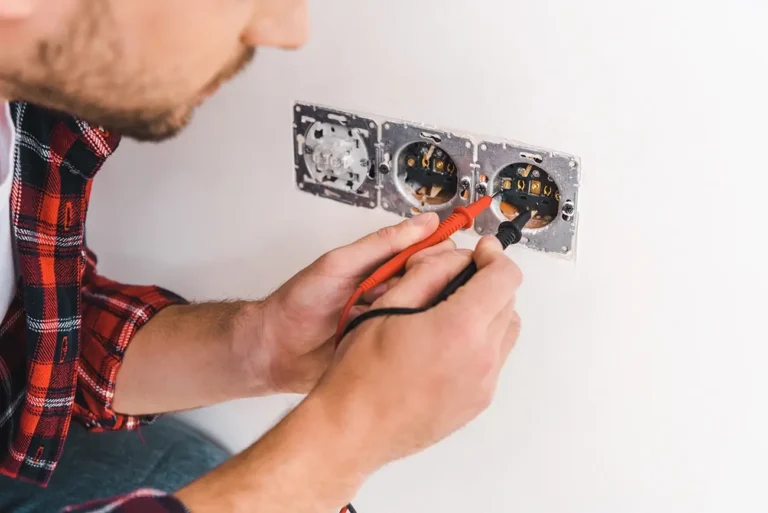
(Suggested Image: An electrician using a digital multimeter while an African American homeowner observes—clean, high-quality, realistic photo.)