Why Your Lights Keep Flickering And What It Actually Means

Light flickering is one of those things most people notice but rarely take seriously. It’s easy to assume it’s just a bad bulb, old wiring, or the house “doing what houses do.” Some people ignore it for years because the lights eventually stop flickering and everything seems fine again. But here’s the truth: lights don’t flicker for no reason. They flicker because something in the electrical system is changing, struggling, or failing—sometimes slowly, sometimes suddenly, always intentionally.
Electricity does not give dramatic warnings. It starts with the smallest signs: a flicker when the microwave runs, a sudden dim when the AC kicks on, a pulsing light in a bedroom, or a fixture that brightens and fades unpredictably. Those little signs are the electrical system trying to communicate long before the situation becomes serious. That communication is easy to miss if you don’t know what it’s trying to tell you.
Flickering is one of the earliest and most important symptoms of unstable voltage, loose wiring, panel problems, overloaded circuits, or utility-side issues. And the risk is not just annoying lighting—it can lead to overheating, arcing, equipment failure, and in the worst cases, house fires. Understanding why flickering happens helps you catch problems early instead of waiting for the electrical system to force your attention.
Why Flickering Seems More Common Now Than Years Ago
Many homeowners feel like lights never used to flicker this much. They’re right. Modern homes place far more demand on electrical systems than past generations ever did. Even a home built in the early 2000s wasn’t designed for what we’re plugging in today.
Every room now hosts multiple screens, LED fixtures, chargers, smart devices, gaming consoles, Wi-Fi hubs, air purifiers, high-wattage appliances, and equipment that didn’t exist twenty years ago. HVAC systems draw more power. Water heaters draw more power. Homes with EV chargers add even more strain.
The electrical load has increased, but the wiring in many homes hasn’t changed at all. When a system designed for one era is pushed into another, the signs show up where the system is most sensitive: the lights.
Understanding What Flickering Actually Is
When lights flicker, voltage is fluctuating. Voltage should stay stable; it’s meant to deliver consistent power at all times. Flickering means the power feeding the bulb is either spiking, dropping, or becoming unstable. Lights react faster than any other appliance, so they’re the first to show the disturbance.
The cause of that disturbance can vary widely. Sometimes it’s simple. Sometimes it’s so serious it needs immediate attention. Most homeowners can’t tell the difference just by looking at the lights, which is why flickering shouldn’t be ignored.
Loose Wiring: The Invisible Problem Behind Many Flickering Lights
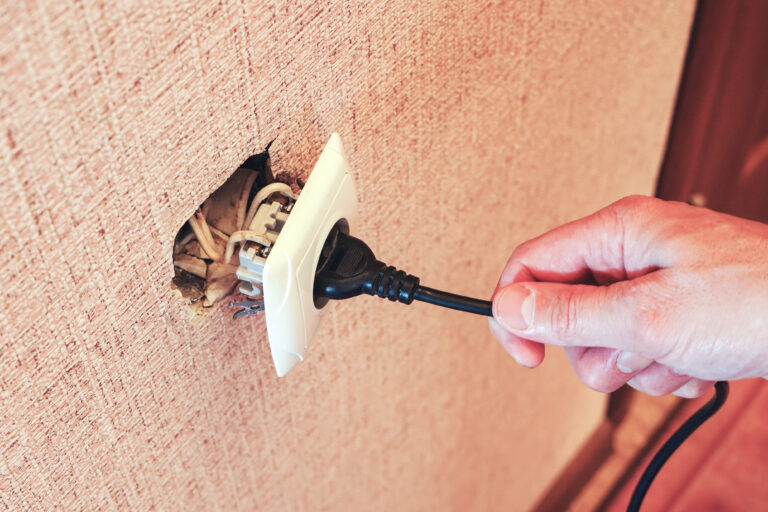
One of the most dangerous reasons lights flicker is loose wiring. A loose connection creates intermittent contact. When electricity travels over a loose connection, it jumps the gap. That jump produces heat. Heat damages insulation. Damaged insulation exposes conductors. Exposed conductors cause arcing. Arcing ignites surrounding material.
This process often happens silently and invisibly behind walls, above ceilings, inside junction boxes, or within the electrical panel.
A loose wire can be located:
- behind a switch
- behind an outlet
- inside a light fixture
- in the junction box above the fixture
- in the panel
- in the service lines feeding the home
You may never see the loose point yourself.
But the lights will.
This is why flickering is not something to wait on. What you see as a small annoyance can be the system hinting at a dangerous breakdown behind the scenes.
Circuit Overload: The Home Is Asking for More Than the Wiring Can Give
If lights dim or flicker when heavy appliances turn on, the circuit is overloaded. The wiring simply cannot deliver the power required without voltage dropping. Older homes in particular were not built for high-demand modern devices. A single bedroom circuit might now be carrying a gaming setup, multiple screens, LED lighting, chargers, and space heaters—all on wiring originally meant for a lamp and maybe a radio.
When the demand exceeds what the wiring can safely carry, the voltage drops. The lights respond instantly. That drop is flicker.
This isn’t “just older homes being older.” This is a mismatch between modern power usage and outdated wiring. And that mismatch doesn’t fix itself.
Fixture or Bulb Issues: The Simplest Cause — But Not Always the Right One
Sometimes the flickering really is just the bulb or the fixture.
LED bulbs, especially cheaper ones, can flicker if the internal driver starts failing. They can also flicker on older dimmers not rated for LED loads. Even a slightly loose bulb can cause inconsistent brightness.
But homeowners often assume it’s the bulb without checking anything else. Replacing the bulb may mask the symptom temporarily, but if the flicker returns—or if multiple lights in different rooms flicker—the cause is almost certainly deeper in the wiring or panel.
One fixture flickering may be a bulb.
Multiple fixtures flickering is a system problem.
Failing Switches and Dimmers: The Small Devices That Cause Big Problems
Older switches and dimmers wear out internally. When the internal contacts loosen, electricity flows inconsistently. That inconsistency produces flicker, humming, buzzing, or heat. Some switches from past decades cannot handle the load of modern LED lighting and respond unpredictably.
A failing switch is cheap to replace.
But ignoring it can allow heat damage to spread into the wiring box, which is far more expensive and dangerous.
Electrical Panel Issues: When the Heart of the System Starts Slipping
Your electrical panel is the brain of the entire home. If a breaker becomes loose, worn, or overheated, it will deliver inconsistent voltage to the circuits it controls. Panels older than 20 years often show signs of fatigue:
Breakers that trip unpredictably.
Breakers that fail to trip when they should.
Burn marks.
Corrosion.
Buzzing.
Hot spots.
Lights across the home may flicker when the panel is struggling.
Panels do not last forever. Breakers age. Connections loosen. Internal parts deteriorate. And when a panel starts sending inconsistent power, the lights are the first things to snitch.
Utility Issues: When the Problem Is Outside the Home
Not all flickering comes from inside the house.
Sometimes the utility company’s equipment is the root cause. Damaged power lines, aging transformers, tree branches touching wires, construction disturbances, or voltage drops from the grid can all cause lights to flicker.
When the issue is external, neighbors often experience the same behavior, but even then, it doesn’t rule out internal issues without a proper inspection. It’s entirely possible to have both a utility problem and an in-home wiring issue at the same time.
The Part Most Homeowners Never Hear: Flickering Is a Symptom, Not the Problem
The lighting is not malfunctioning.
It’s reporting a malfunction.
Flickering is your early warning sign. It’s not random. It’s not cosmetic. Something is causing it, and that something rarely stays small for long.
Electrical problems escalate quietly.
Wires heat up slowly.
Connections loosen gradually.
Panels degrade silently.
By the time smoke or fire appears, the warnings have been showing themselves for months.
Flickering is the home’s way of asking for help before things get worse.
When Flickering Means “Call an Electrician Now”
There are flickering patterns that signal immediate danger:
Lights flicker AND you hear buzzing.
Lights flicker AND the smell of burning plastic appears.
Lights flicker across multiple rooms at once.
Lights brighten and then dim like a pulse.
Lights flicker when no appliances are turning on.
Lights flicker after storms or outages.
These are signs of serious internal issues—loose neutrals, arcing, panel failure, or damaged service conductors. These are not conditions you wait on.
How Radiant Electric Diagnoses Flickering the Right Way
A proper diagnosis doesn’t start with replacing a bulb. It starts with examining the entire electrical path:
The fixture.
The switch.
The wiring in the box.
The circuit path.
The breaker.
The internal connections in the panel.
The service entry feeding the home.
Even the grounding and bonding system.
Flickering is the symptom.
Finding the cause requires understanding the entire system.
Radiant Electric approaches flickering with safety first, not guessing. The goal is not just to stop the flicker. The goal is to stop the problem behind the flicker so it never escalates.
Flickering Isn’t Annoying — It’s Important
The worst thing a homeowner can do is ignore flickering lights. They are early signs of electrical stress, aging equipment, failing wiring, or unsafe voltage fluctuations. Whether the cause is minor or serious, flickering never happens “just because.”
If your lights flicker, dim, pulse, or behave unpredictably, it’s time for a professional inspection. Waiting only gives the underlying problem more time to grow.
Radiant Electric is trained to identify the true cause, fix it safely, and protect your home from future electrical risks. When lights flicker, something is speaking. It’s worth listening.