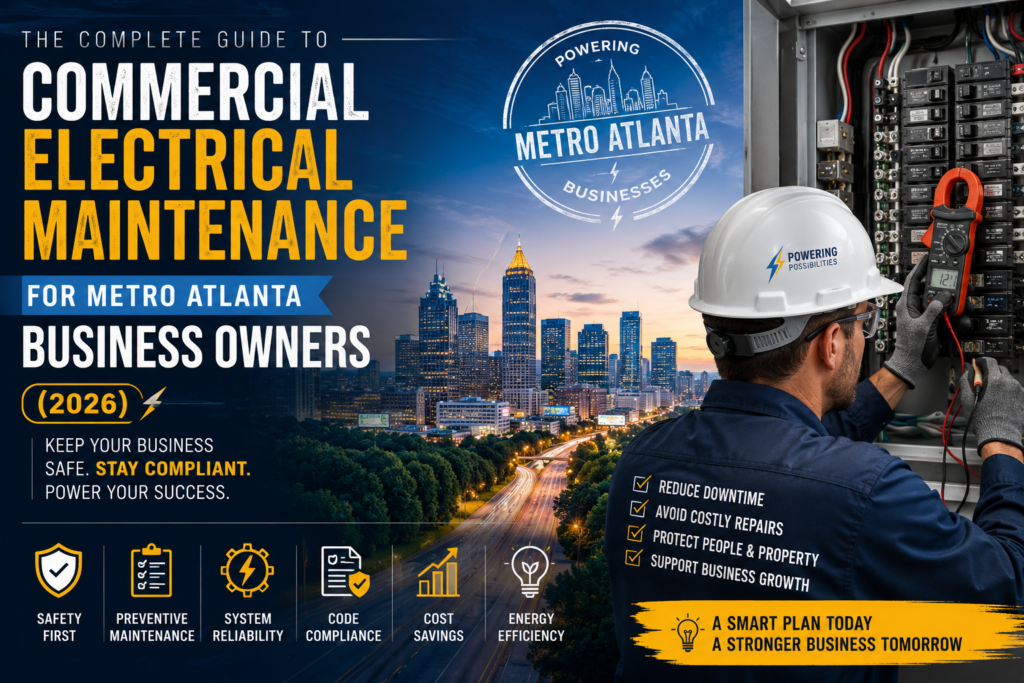
The Complete Guide to Commercial Electrical Maintenance for Metro Atlanta Business Owners (2026)
For a business, electrical reliability isn’t a convenience it’s a foundation. When the power works, no one thinks about it. But when an electrical problem strikes, the consequences ripple through everything: operations grind to a halt, customers walk out, inventory spoils, equipment fails, and revenue evaporates by the hour. In the worst cases, an electrical fault becomes a safety incident or a fire, exposing the business to liability that can dwarf any short-term savings from deferred maintenance.
Yet commercial electrical systems are among the most neglected parts of a business’s physical infrastructure. They’re hidden in panels, ceilings, and walls, and because they usually work without complaint, they get ignored until the day they don’t.
This guide goes beyond generic advice. Below you’ll find specific, actionable steps you can take many of them this week to keep your commercial electrical system safe, compliant, and reliable. It’s written for business owners and property managers across Gwinnett County and Metro Atlanta, whether you run a restaurant in Buckhead, an office in Alpharetta, a retail storefront in Duluth, a warehouse in Norcross, or an institutional facility anywhere in the region.
Why Commercial Electrical Maintenance Is Different and Critical
It’s tempting to think of commercial electrical work as simply “residential electrical, but bigger.” In reality, commercial systems are a different world. They handle far heavier and more continuous loads, frequently use three-phase power rather than the single-phase power found in homes, and must satisfy stricter codes, inspection requirements, and safety standards. A commercial kitchen, a server room, a retail floor full of refrigerated cases, and a warehouse full of machinery all place demands on the electrical system that no home ever would.
That heavier demand means commercial systems experience more wear. Connections loosen under repeated thermal cycling, breakers age and weaken, insulation degrades, and panels that were adequate when the building opened slowly fall behind as the business adds equipment and grows. Proactive maintenance is what keeps that gradual decline from turning into sudden, expensive failure.
A Practical Maintenance Schedule You Can Actually Follow
One of the biggest reasons commercial electrical maintenance gets neglected is that “maintain your electrical system” is too vague to act on. So here’s a concrete schedule. Assign each item to a person and put it on the calendar.
Monthly
- Test every GFCI outlet (press TEST, confirm power cuts, press RESET). Pay special attention to kitchens, bathrooms, and any outlet near water.
- Test emergency lighting and illuminated exit signs by pressing the test button or simulating a power loss. Confirm they stay lit for at least 90 seconds.
- Walk the property and note any flickering lights, warm cover plates, buzzing fixtures, or outlets that feel loose.
Quarterly
- Inspect your electrical panel area. Confirm nothing is stored within three feet of the panel, the door closes, and labels are still legible.
- Check that all visible cords, power strips, and equipment connections are intact and not daisy-chained.
- Review your energy bills for unexplained increases, which can signal a developing fault.
Annually
- Schedule a professional electrical inspection with a licensed commercial electrician.
- Have the electrician perform a thermal (infrared) scan of your panels to find hot spots before they fail.
- Test your backup generator under load if you have one.
- Review whether any equipment added during the year pushed your system closer to capacity.
Every 3–5 years:
- Have a full load analysis done, especially if your business has grown or changed.
- Reassess whether your panel and service capacity still match your actual usage.
Specific, Actionable Maintenance Tips
1. Get an Infrared Thermal Scan of Your Panels
This is the single most valuable maintenance service most business owners have never heard of. An electrician uses an infrared camera to photograph your energized panels and connections. Loose or failing connections show up as hot spots long before they fail — often weeks or months ahead. Catching one overheating breaker or lug this way can prevent a fire and a shutdown. Ask specifically for an “infrared scan” or “thermal imaging” during your annual inspection.
2. Have Panel Connections Torqued to Spec
Over years of thermal cycling — heating up under load, cooling when idle — the screw connections inside your panel work loose. Loose connections arc, overheat, and start fires. A licensed electrician can check and re-torque connections to manufacturer specification. This is cheap insurance that almost no one does until there’s a problem.
3. Keep the Three-Foot Rule Around Every Panel
Electrical code requires at least 36 inches of clear working space in front of electrical panels. Walk your building today and look at every panel. If there’s a shelf, a stack of boxes, a mop bucket, or merchandise in that zone, move it now. This is one of the most common code violations inspectors cite — and it’s free to fix.
4. Map and Label Every Circuit
Pull out your panel directory. Is it accurate, or is it blank, faded, or labeled “misc”? An accurate circuit map means that when something goes wrong, you can kill power to the right area in seconds instead of shutting down the whole building. Have your electrician map every circuit during their next visit and create a clean, laminated directory.
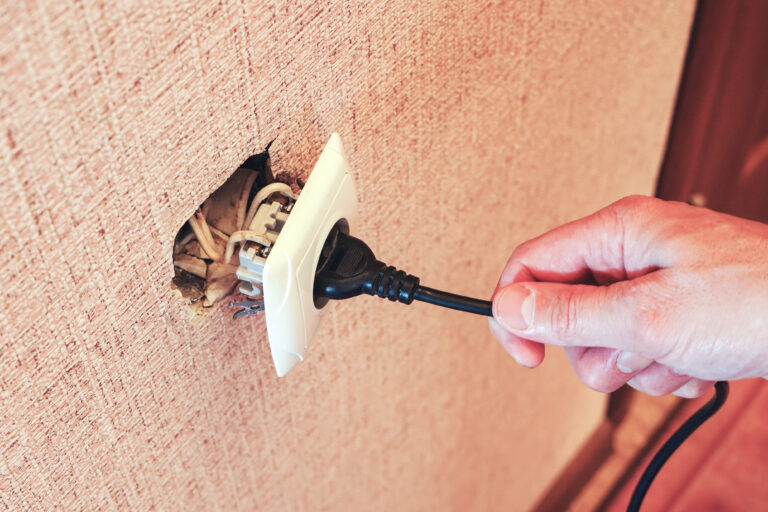
5. Replace Any Outlet That Doesn’t Grip a Plug
In a commercial setting, worn outlets are everywhere — and a loose outlet arcs every time the connected equipment cycles. Test outlets by plugging in a device; if the plug falls out or wobbles, flag that outlet for replacement. It’s a quick, inexpensive fix that removes a real fire risk.
6. Put High-Demand Equipment on Dedicated Circuits
Commercial kitchen equipment, large copiers, server racks, HVAC, and heavy machinery should each be on their own dedicated circuit, not sharing with general outlets. Sharing circuits with high-demand equipment is a leading cause of nuisance trips and overheating. If you’re running a major appliance off a shared circuit, have a dedicated line installed.
7. Install Surge Protection at the Panel Not Just at the Outlet
Plug-in surge strips only protect what’s plugged into them, and they don’t stop a large surge from entering through your HVAC or other hardwired equipment. A panel-mounted (Type 2) surge protective device guards your entire electrical system at once, including the expensive systems that aren’t on a plug. For any business running POS systems, servers, or sensitive electronics, this is essential.
8. Upgrade to LED and Add Occupancy Sensors
If your building still runs fluorescent tubes or older lighting, converting to LED typically cuts lighting energy use by 50–75% while improving brightness and reducing heat and maintenance. Adding occupancy sensors in storerooms, restrooms, and offices means lights aren’t burning in empty rooms. These upgrades pay for themselves and reduce load on your system.
9. Test Your Backup Generator Under Real Load
A generator that’s never tested is a generator you can’t count on. Don’t just start it — test it under actual load periodically so you know it will carry your critical systems when the grid goes down. Schedule this as part of your annual maintenance, and keep fuel and batteries fresh.
10. Know Your Building’s Age and Wiring Type
If your building is decades old, find out what’s behind the walls. Older commercial buildings may have outdated wiring, undersized service, or panels from manufacturers with known reliability problems. Knowing what you have lets you plan upgrades proactively. A commercial panel or service upgrade is far cheaper and less disruptive when planned than when forced by a failure.
11. Don’t Let “Temporary” Wiring Become Permanent
Extension cords running across floors, power strips chained together, and temporary drops feeding permanent equipment are all common in busy commercial spaces — and all are hazards and code violations. If you’ve been relying on a “temporary” cord for more than a few weeks, you need a permanent outlet installed there.
12. Keep a Maintenance Log
Document every inspection, repair, and upgrade with dates and details. A maintenance log proves due diligence to insurers and inspectors, helps you spot recurring problems, and is valuable documentation if you ever sell or lease the property. It also keeps maintenance from slipping through the cracks when staff changes.
Recognizing Common Commercial Electrical Problems
Knowing the warning signs lets you act before a minor issue becomes a major one. Train your staff to report any of these immediately:
- Frequently tripping breakers, which signal overloaded or faulty circuits. Resetting a breaker again and again without finding the cause is dangerous.
- Flickering or dimming lights, especially when equipment cycles on, which can indicate wiring problems, loose connections, or a system straining against its capacity.
- Warm or discolored outlets, switches, or panels, which are a serious fire hazard and demand immediate inspection.
- Burning, fishy, or unusual smells, which require you to stop and call a professional immediately never ignore the smell of burning in a commercial building.
- Unexplained high energy bills, which can point to inefficient systems or hidden electrical faults wasting power.
- Buzzing or humming sounds from panels, outlets, or fixtures, often a symptom of loose connections that are arcing.
- Outlets or switch plates that are cracked, broken, or warm, which expose live components and create shock and fire risk.
Any one of these warrants a call to a licensed commercial electrician. Together, they form a checklist that property managers and business owners should review regularly.
Electrical Considerations by Industry
Different businesses place very different demands on their electrical systems. Understanding the specific needs of your industry helps you maintain the right things.
Restaurants and food service run some of the most demanding electrical environments of any business. Commercial kitchen equipment draws enormous power, refrigeration absolutely cannot be allowed to fail, and the combination of heat, moisture, and constant operation stresses the electrical system continuously. Practical priorities here: dedicated circuits for every major appliance, GFCI protection throughout the kitchen, robust ventilation for electrical equipment, frequent inspections, and reliable backup power for refrigeration and freezers. The cost of one freezer full of spoiled inventory often exceeds years of maintenance.
Retail businesses depend on electrical reliability in ways that aren’t always obvious. Point-of-sale systems must stay online to process sales — a POS outage during a busy weekend is lost revenue you never recover. Lighting does the critical job of showcasing products and shaping the customer experience. Security and surveillance systems protect inventory. Practical priorities: panel-level surge protection for POS and electronics, well-designed and energy-efficient display lighting, and backup power for security and payment systems.
Offices live and die by their technology infrastructure. Server rooms generate heat and demand stable, protected, properly cooled power. Dozens or hundreds of workstations, combined with HVAC and lighting, require well-balanced electrical loads so no single circuit is overloaded. Practical priorities: dedicated and protected circuits for server rooms, UPS battery backup for critical systems, surge protection throughout, and load balancing across the panel.
Warehouses and industrial facilities often require specialized commercial electrical expertise. High-bay lighting, heavy machinery, three-phase power, and large-scale operations all demand an electrician experienced in industrial environments. Practical priorities: proper circuit protection sized for motor loads, LED high-bay conversions for major energy savings, clearly marked disconnects for machinery, and regular inspection of connections that vibrate loose under heavy equipment operation.
Schools and institutional facilities carry a special responsibility because they serve the public, often including children. Safety systems, security and access control, emergency lighting, and strict code compliance are all paramount. Practical priorities: rigorously maintained emergency and exit lighting, tested and reliable security and access systems, GFCI protection throughout, and a contractor who understands the heightened standards institutional work demands.
Understanding Permits and Code Compliance
Commercial electrical work in Gwinnett County requires proper permits and inspections, handled through the Gwinnett County Building Services department. This isn’t bureaucratic box-checking — it’s how the work gets verified as safe.
Working with a licensed contractor ensures that everything is done to code and properly documented, which matters in several concrete ways. Your insurance may not cover damage from unpermitted work. A failed inspection during a build-out or renovation can delay your opening by weeks. And when you eventually sell or lease the property, undocumented or non-compliant electrical work becomes a liability that can derail the deal. Doing it right the first time, with permits and inspection, protects you on every front.
When to Call a Commercial Electrician
The best time to call a commercial electrician is before you have an emergency. Reach out when you are:
- Opening, expanding, or renovating a commercial space, so the electrical system is designed and installed correctly from the start.
- Adding significant equipment or load, to ensure your system can handle it safely before you plug it in.
- Experiencing any of the warning signs described above, before they escalate into a failure or fire.
- Due for a compliance inspection, to stay ahead of code requirements rather than scrambling to meet them.
- Buying or leasing a commercial property, to know exactly what electrical condition you’re inheriting before you sign.
- Looking to reduce energy costs through efficient lighting and system upgrades that pay for themselves over time.
In every one of these situations, a proactive call to a licensed professional saves money, prevents disruption, and protects everyone in the building.
Frequently Asked Questions
How often should a commercial property have an electrical inspection?
Most commercial properties should be professionally inspected at least once a year, ideally including an infrared thermal scan of the panels. High-demand operations such as restaurants, manufacturing facilities, and businesses that operate around the clock may need inspections more frequently. Regular inspection is the single most effective way to prevent unexpected electrical failures.
What’s the difference between residential and commercial electrical work?
Commercial electrical systems handle much larger and more continuous loads, frequently use three-phase power rather than the single-phase power in homes, and must meet stricter code, safety, and inspection requirements. Commercial work requires an electrician with specific experience in commercial environments — it is genuinely a different discipline from residential work.
Can electrical maintenance really lower my energy bills?
Yes, and often significantly. Upgrading to LED lighting can cut lighting energy use by 50–75%, adding occupancy sensors eliminates wasted power in empty rooms, and finding and fixing hidden electrical faults stops power from being wasted. Because these savings recur every month, efficiency upgrades frequently pay for themselves within a year or two.
Do I need permits for commercial electrical work?
Yes. Commercial electrical work requires proper permits and inspections. A licensed contractor handles the permitting process and ensures the work is properly documented and code-compliant — which matters for safety, insurance, and the future sale or lease of your property.
What should I do if I smell something burning in my building?
Treat it as an emergency. Stop what you’re doing, and if the smell is strong or you can identify its source, cut power to that area at the panel if it’s safe to do so. Call a licensed electrician immediately, and if there’s any sign of fire, smoke, or immediate danger, evacuate and call emergency services. The smell of burning in a commercial building should never be ignored or postponed.
How do I know if my building’s electrical system needs an upgrade?
Common signs include frequent breaker trips, an inability to add new equipment without overloading circuits, electrical infrastructure that’s decades old, rising energy costs, flickering lights, and recurring electrical problems. A professional load analysis and assessment will determine whether an upgrade to your panel, service, or wiring is warranted.
What is an infrared thermal scan and do I need one?
An infrared thermal scan uses a special camera to detect heat in your energized electrical panels and connections. Hot spots reveal loose or failing connections weeks or months before they fail. It’s one of the most cost-effective preventive measures available for a commercial property, and it’s worth requesting as part of your annual inspection.
Protect Your Business — Call Metro Atlanta’s Commercial Electrical Experts
Radiant Electrical & More Inc is a licensed, insured, family-owned electrical contractor serving businesses across Gwinnett County and Metro Atlanta — from Buckhead and Midtown to Johns Creek, Alpharetta, Duluth, and beyond. We provide commercial panel and service upgrades, wiring, lighting, generators, surge protection, security systems, and code-compliance work for restaurants, offices, retail spaces, warehouses, and institutional properties.
Whether you need a one-time inspection, an infrared panel scan, a system upgrade, or an ongoing maintenance partner you can trust, we’re ready to help keep your business safe, compliant, and powered.
📞 Call or text (678) 878-0487 to schedule a commercial assessment. 🌐 Contact us here to discuss your property’s specific needs.
Radiant Electrical & More Inc
Gwinnett’s trusted electricians for homes and businesses.