Understanding Circuit Breakers and How They Actually Protect Your Home
Circuit breakers are one of those things every homeowner interacts with but almost no one fully understands. Everyone knows how to flip a breaker back on when it trips, and most people have had the experience of halfway resetting one, then wondering if they pushed it the right way. It’s a simple task on the surface, but the job breakers do inside your home is far more critical than most people realize.
A breaker isn’t just a switch. It isn’t a fuse replacement or a “try again” button for your appliances. A breaker is a safety device designed to stop dangerous electrical conditions long before the homeowner ever sees a spark, smells smoke, or hears anything unusual. In many cases, the breaker is the only thing standing between a home and a fire.
Understanding how breakers work—and more importantly, how they fail—gives homeowners a better sense of what their electrical system is telling them. When a breaker trips, it’s speaking. When it trips repeatedly, it’s shouting. When a breaker never trips at all despite obvious electrical issues, that silence can be the most dangerous thing of all.
This isn’t about scaring anyone. It’s about explaining an invisible system that carries thousands of watts of power through a home every single day. Breakers manage all of it. When they’re doing their job properly, they protect your appliances, wiring, and your family. When they’re not, the risk becomes real.
Let’s take a closer look at what breakers actually do, why they trip, how they age, and the warning signs homeowners should never ignore.
What a Breaker Really Does
Most people understand the simplest version of the explanation: a breaker “turns off” when there’s a problem. But the mechanics behind that are far more interesting and important.
Electricity always tries to take the easiest path. If too much flows through a wire, the wire will heat up. As it heats, the insulation around the wire breaks down. Eventually, the wire reaches a temperature where it can ignite the wood framing around it. This all happens quietly behind the walls. There is no early warning siren, no flashing light, no alert. The wiring simply starts heating like an invisible stovetop coil.
Breakers are designed to detect the beginning of that overheating process and shut everything down instantly.
The breaker’s entire purpose is safety. It does not care about convenience, and it does not care whether the homeowner needs the microwave, AC, and hair dryer running at the same time. It only cares about whether the wire is operating safely.
If it isn’t, the breaker cuts the power.
So when a breaker trips, the system is not malfunctioning—it’s doing exactly what it’s designed to do.
Why Breakers Trip
There are three primary reasons why a breaker will trip, and understanding them helps homeowners know the difference between harmless and serious issues.
But we’re not going to use technical jargon. Here’s the real explanation in everyday language:
Reason One: The circuit is overloaded.
This is the most common situation. Too many devices are plugged into a circuit that can’t handle the demand. The wiring is being asked to carry more power than it safely can. When that happens, the breaker trips to prevent overheating.
Homes built in earlier decades were not designed for modern power usage. Back then, people had a few lamps, a TV, maybe a radio. Today, the same circuit may be powering multiple screens, chargers, smart devices, LED lighting, gaming systems, heating appliances, and more. The wiring didn’t change—only the demand did.
Reason Two: There’s a short circuit.
This is when a “hot” wire touches a neutral or ground wire. Short circuits create sudden surges of electricity, much higher than the wire can handle. This is extremely dangerous. A breaker will snap off immediately to prevent a fire.
Short circuits can be caused by damaged wires, loose connections, old outlets, or internal fixture failures.
Reason Three: There’s a ground fault.
This is when electricity takes a path it wasn’t meant to—usually because water or moisture has entered the wiring, an appliance is damaged, or a connection has weakened. It’s especially common in outdoor circuits, kitchens, bathrooms, and garages.
Ground faults are serious because they can lead to shock hazards. Breakers designed for ground fault protection (GFCI breakers) trip instantly to protect people.
Why Breakers Trip Repeatedly
One breaker trip is usually not a major concern. A second trip is worth paying attention to. A third trip in the same day or week should not be ignored.
Repeated tripping almost always means the circuit is being asked to do too much or something inside the wiring is deteriorating.
If a breaker trips repeatedly:
- It could be loose wiring inside an outlet or switch.
- It could be a failing appliance pulling more current than it should.
- It could be a breaker becoming weak.
- It could be damaged insulation inside the wall.
- It could be an overloaded circuit that needs to be split.
Ignoring repeated trips is one of the top causes of electrical fires. When the breaker is working too hard, heat builds inside the panel and in the wiring it protects.
A tripping breaker is not the problem—it’s the warning about the problem.
What Homeowners Often Misunderstand About Breakers
Breakers do not last forever.
They wear out just like anything else with mechanical parts.
The more they trip, the weaker they become. A weak breaker may trip too easily—or more dangerously, not trip when it should. Homeowners often think a breaker that “never trips” is strong or reliable. In reality, an old breaker that stays on during dangerous wiring conditions is failing silently.
Another misconception is that flipping a breaker fully fixes the issue. Resetting it only restores power; it does not resolve the cause of the trip.
Finally, many homeowners believe breakers only serve as a reset switch. They don’t realize that breakers are lifesaving devices engineered to detect conditions the homeowner never sees.
Warning Signs That a Breaker or Panel Is Failing
Some signs are subtle. Others are loud and obvious. But none should be dismissed.
Buzzing or humming from the panel is not normal.
A breaker that feels warm is not normal.
A breaker that won’t stay reset is not normal.
Lights dimming when appliances run is not normal.
Burn marks around a breaker are extremely dangerous.
A breaker that trips inconsistently—sometimes weeks apart—is not “fine.”
Each of these signs means a trained electrician needs to inspect the system. Breakers live inside a metal box for a reason. They withstand enormous electrical power every day. When something changes in how they behave, it’s a sign the system needs attention.
How Breakers Protect Your Appliances, Not Just Your Wiring
Breakers don’t only prevent fires—they protect your appliances from electrical damage. When a circuit becomes unstable, appliances experience stress that shortens their lifespan. HVAC systems, refrigerators, ovens, washers, dryers, and computers are especially vulnerable. Voltage irregularities can destroy internal boards, motors, relays, and sensors.
A single unsafe circuit can take out multiple appliances in the same year.
Breakers are the first line of defense. When they trip properly, they prevent expensive damage long before it reaches your equipment.
Why Electrical Panels Need More Attention Than Most Homes Receive
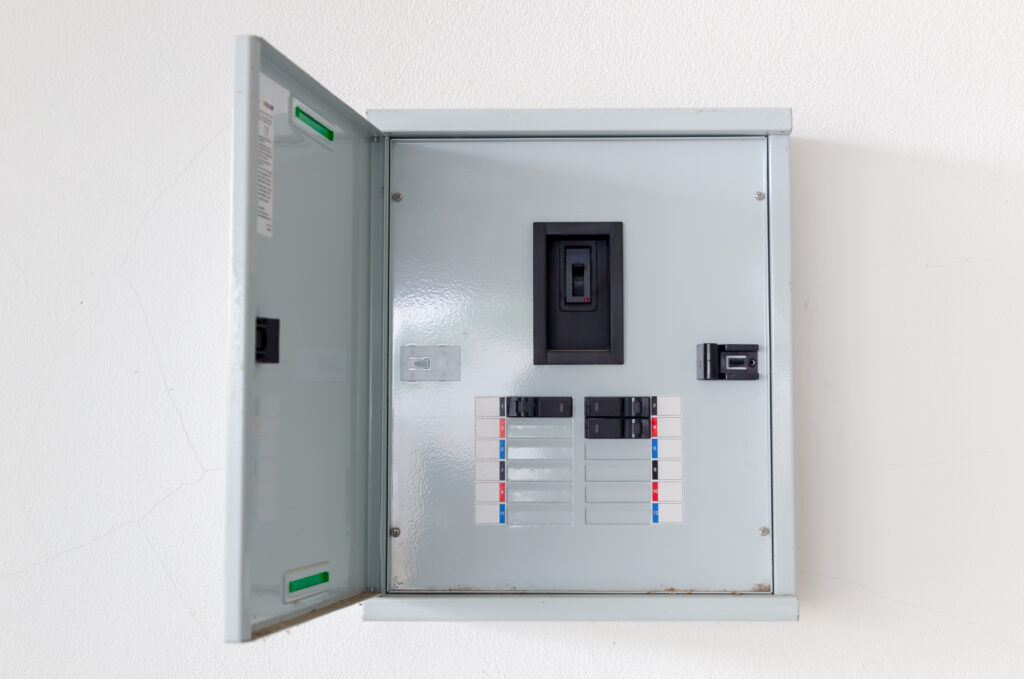
Your electrical panel is the heart of your entire home’s power. Every light, outlet, appliance, and system runs through it. But most panels go decades without a checkup even though they’re designed for regular professional maintenance.
Panels installed 20–30+ years ago were not designed for the electrical loads of modern households. Many are still functioning, but functioning doesn’t mean safe. Heat damage, loose breakers, worn bus bars, rust, and outdated components cause inconsistent performance, including breaker failure and flickering lights.
An electrician evaluates not just the breakers, but the panel’s grounding, bonding, overall load, and internal connections. If the panel is aging or showing signs of stress, upgrading it doesn’t just improve capacity—it dramatically increases safety.
How Radiant Electric Approaches Circuit Breaker and Panel Diagnostics
When breakers act up, Radiant Electric doesn’t guess. Diagnostics begin with understanding the behavior the homeowner is seeing. Then the electrician traces the issue step by step.
They examine:
- the panel
- the breaker feeding the problem circuit
- the circuit path
- the outlet or switch locations
- the appliances or devices involved
- and the wiring connections at every stage
Sometimes the issue is small. Sometimes it’s major. But diagnosing a breaker issue properly means looking at the entire system, not just flipping a switch.
When a breaker trips repeatedly, the goal is not to reset the breaker—it’s to identify why the breaker needed to trip in the first place.
Breakers Aren’t Just Switches , They’re Safety Devices
Breakers are more than “those switches in the panel.” They’re one of the most important safety features in your entire home. They protect your wiring, your appliances, and your family. But they can only do their job if they’re working properly.
Understanding what breakers are actually telling you—when they trip, when they don’t trip, when they heat up, when they buzz—helps you stop electrical problems before they become emergencies.
If your breakers act irregularly, if your panel hasn’t been inspected in years, or if you’re noticing flickering, dimming, tripping, or unexplained electrical behavior, it’s time to let a licensed electrician take a closer look.
Radiant Electric provides professional diagnostics to identify the cause, fix the issue the right way, and restore stability and safety to your electrical system.